Exclusives

John Fishell - maverick-country.com

Artist Spotlight – John Fishell & Deepak Ram

With new album Notorious Partners in Crime, John Fishell and flautist Deepak Ram fuse East and West into an adventurous collaboration built on friendship, respect, and fearless creativity  You’ve described your partnership with Deepak Ram as “like a fancy wine with a greasy cheeseburger.” What first drew you to this collaboration, and how did you know it would work musically?  I met Deepak in the mid-90s when I moved to South Africa, and we’ve been close friends ever since. Over the years, we both moved around the US until we found ourselves in the same place — my hometown of Washington DC. That’s when I decided to leave teaching and put everything into being an artist. Deepak and I are very sensitive to each other’s strengths, and our instruments just sound good together. We played a few small shows, realised it clicked, and now here we are with a full record and tour.  The new album Notorious Partners in Crime reimagines some of Deepak’s instrumentals with your lyrics. How did you approach writing words for pieces that already had strong identities in instrumental form?  I had to be very careful. For “Lenasia,” I went through countless rewrites trying to capture Deepak’s stories of growing up in apartheid-era South Africa with some kind of poetry. Deepak prefers me to follow his melodies note-for-note, but I haven’t managed that yet. Instead, I used his motifs as instrumental breaks and sections within the songs. My priority was to leave his parts intact while shaping the pieces into proper popular music songs.  “Space Time” is an especially adventurous track, shifting time signatures and blending genres. How do you balance technical complexity with keeping songs accessible?  For me it’s about pairing complexity with a simple, effective melody or a groove that works with a straightforward lyric. That makes it more digestible. The Beatles and Led Zeppelin were masters at this. When I play those songs, I’m counting frantically in my head while trying to look relaxed — Deepak, of course, handles it effortlessly.  You lost several guitars in a flood but recorded “If I Were a Carpenter” on a restored 1952 Gibson J-45 from your father. How did that affect your connection to the track?  Honestly, I have a stronger bond with that guitar than the song itself. It’s been in my life forever, and it just suited playing with Deepak. The flood was devastating — most instruments were ruined. But the J-45 was at a repair shop, so it survived. That guitar carries enormous emotional weight.  Your career has spanned rock, jazz, world music, and teaching. How did those paths prepare you for this cross-cultural project?  Deepak is a bansuri master, while I’m more of a jack-of-all-trades. But I’ve always been the “pop/rock guy” who brings punch and structure to jazz, classical or world music. What really matters is our mutual respect and the supportive relationship we share. That’s the foundation.  You’ve got a UK tour coming up in October. What can audiences expect from a Notorious Partners in Crime live show?  This time we’ll be performing as an acoustic duo, so everything will be fully exposed — no percussionists or bassists to hide behind! It will be more intimate, which is both exciting and terrifying. I’ll lean on the strength of the songs, while Deepak is always wonderful to watch in any context.  With Notorious Partners in Crime about to be released, what excites you most about this next chapter?  I hope this is only the beginning. We definitely have another album in us if this one does well. More than anything, I want to perform this music around the world. If there’s an audience, I want to be there. 

Artist Spotlight – John Fishell & Deepak Ram Read More »
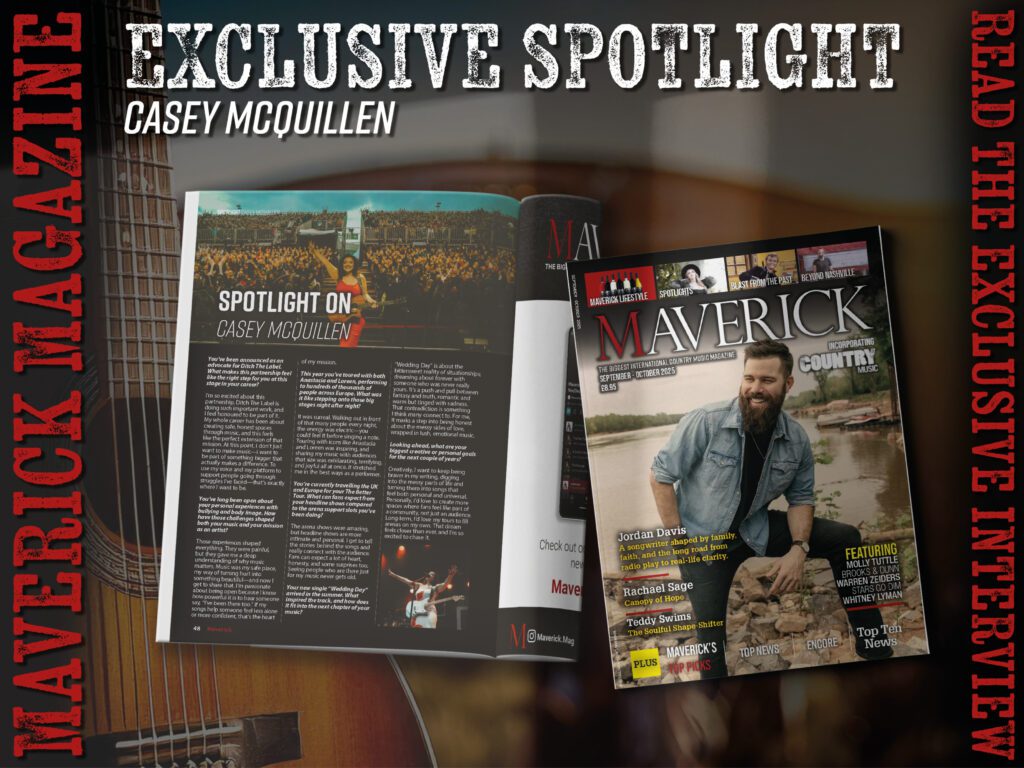
Casey - maverick-country.com

Spotlight – Casey McQuillen

From arena tours to her latest single “Wedding Day,” Casey McQuillen shares how honesty, resilience, and advocacy are shaping her most powerful chapter yet  You’ve been announced as an advocate for Ditch The Label. What makes this partnership feel like the right step for you at this stage in your career?  I’m so excited about this partnership. Ditch The Label is doing such important work, and I feel honoured to be part of it. My whole career has been about creating safe, honest spaces through music, and this feels like the perfect extension of that mission. At this point, I don’t just want to make music—I want to be part of something bigger that actually makes a difference. To use my voice and my platform to support people going through struggles I’ve faced—that’s exactly where I want to be.  You’ve long been open about your personal experiences with bullying and body image. How have those challenges shaped both your music and your mission as an artist?  Those experiences shaped everything. They were painful, but they gave me a deep understanding of why music matters. Music was my safe place, my way of turning hurt into something beautiful—and now I get to share that. I’m passionate about being open because I know how powerful it is to hear someone say, “I’ve been there too.” If my songs help someone feel less alone or more confident, that’s the heart of my mission.  This year you’ve toured with both Anastacia and Loreen, performing to hundreds of thousands of people across Europe. What was it like stepping onto those big stages night after night?  It was surreal. Walking out in front of that many people every night, the energy was electric—you could feel it before singing a note. Touring with icons like Anastacia and Loreen was inspiring, and sharing my music with audiences that size was exhilarating, terrifying, and joyful all at once. It stretched me in the best ways as a performer.  You’re currently travelling the UK and Europe for your The Better Tour. What can fans expect from your headline shows compared to the arena support slots you’ve been doing?  The arena shows were amazing, but headline shows are more intimate and personal. I get to tell the stories behind the songs and really connect with the audience. Fans can expect a lot of heart, honesty, and some surprises too. Seeing people who are there just for my music never gets old.  Your new single “Wedding Day” arrived in the summer. What inspired the track, and how does it fit into the next chapter of your music?  “Wedding Day” is about the bittersweet reality of situationships; dreaming about forever with someone who was never really yours. It’s a push and pull between fantasy and truth, romantic and warm but tinged with sadness. That contradiction is something I think many connect to. For me, it marks a step into being honest about the messy sides of love, wrapped in lush, emotional music.  Looking ahead, what are your biggest creative or personal goals for the next couple of years?  Creatively, I want to keep being braver in my writing, digging into the messy parts of life and turning them into songs that feel both personal and universal. Personally, I’d love to create more spaces where fans feel like part of a community, not just an audience. Long-term, I’d love my tours to fill arenas on my own. That dream feels closer than ever, and I’m so excited to chase it. 

Spotlight – Casey McQuillen Read More »

Vera Black - maverick-country.com

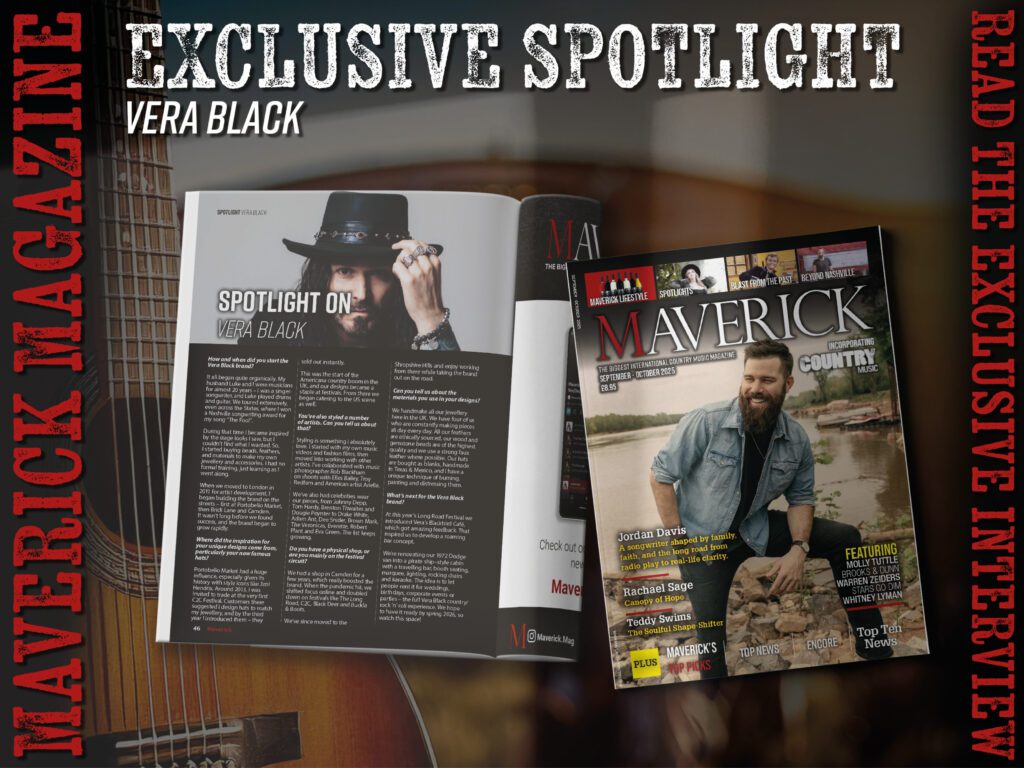
Lifestyle Spotlight – Vera Black

From Portobello Market to global festivals, Vera Black has become a fashion staple of the country and Americana scene. Here she shares her journey, inspirations, and future plans  How and when did you start the Vera Black brand?  It all began quite organically. My husband Luke and I were musicians for almost 20 years – I was a singer-songwriter, and Luke played drums and guitar. We toured extensively, even across the States, where I won a Nashville songwriting award for my song “The Fool”.  During that time I became inspired by the stage looks I saw, but I couldn’t find what I wanted. So, I started buying beads, feathers, and materials to make my own jewellery and accessories. I had no formal training, just learning as I went along.  When we moved to London in 2011 for artist development, I began building the brand on the streets – first at Portobello Market, then Brick Lane and Camden. It wasn’t long before we found success, and the brand began to grow rapidly.  Where did the inspiration for your unique designs come from, particularly your now famous hats?  Portobello Market had a huge influence, especially given its history with style icons like Jimi Hendrix. Around 2013, I was invited to trade at the very first C2C Festival. Customers there suggested I design hats to match my jewellery, and by the third year I introduced them – they sold out instantly.  This was the start of the Americana country boom in the UK, and our designs became a staple at festivals. From there we began catering to the US scene as well.  You’ve also styled a number of artists. Can you tell us about that?  Styling is something I absolutely love. I started with my own music videos and fashion films, then moved into working with other artists. I’ve collaborated with music photographer Rob Blackham on shoots with Elles Bailey, Troy Redfern and American artist Arielle.  We’ve also had celebrities wear our pieces, from Johnny Depp, Tom Hardy, Brenton Thwaites and Dougie Poynter to Drake White, Adam Ant, Dee Snider, Brown Mark, The Veronicas, Everette, Robert Plant and Eva Green. The list keeps growing.  Do you have a physical shop, or are you mainly on the festival circuit?  We had a shop in Camden for a few years, which really boosted the brand. When the pandemic hit, we shifted focus online and doubled down on festivals like The Long Road, C2C, Black Deer and Buckle & Boots.  We’ve since moved to the Shropshire Hills and enjoy working from there while taking the brand out on the road.  Can you tell us about the materials you use in your designs?  We handmake all our jewellery here in the UK. We have four of us who are constantly making pieces all day every day. All our feathers are ethically sourced, our wood and gemstone beads are of the highest quality and we use a strong faux leather where possible. Our hats are bought as blanks, handmade in Texas & Mexico, and I have a unique technique of burning, painting and distressing them.  What’s next for the Vera Black brand?  At this year’s Long Road Festival we introduced Vera’s Blackbird Café, which got amazing feedback. That inspired us to develop a roaming bar concept.  We’re renovating our 1972 Dodge van into a pirate ship–style cabin with a travelling bar, booth seating, marquee, lighting, rocking chairs and karaoke. The idea is to let people rent it for weddings, birthdays, corporate events or parties – the full Vera Black country/rock ’n’ roll experience. We hope to have it ready by spring 2026, so watch this space! 

Lifestyle Spotlight – Vera Black Read More »

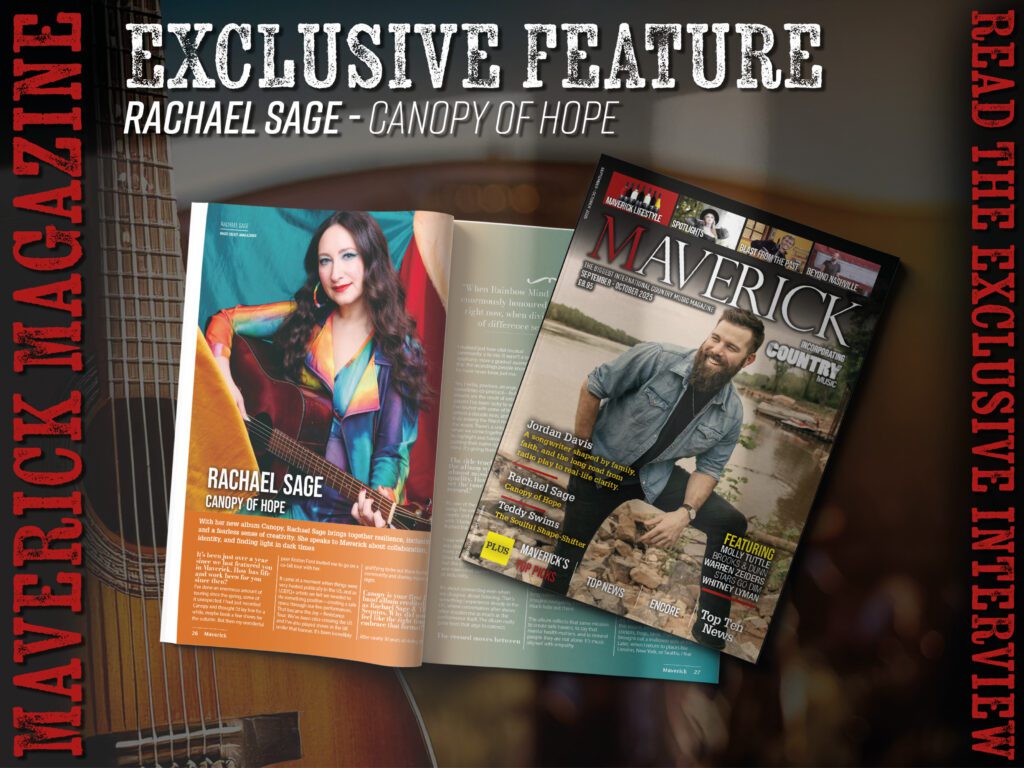
Rachael Sage: Canopy of Hope

With her new album Canopy, Rachael Sage brings together resilience, inclusivity, and a fearless sense of creativity. She speaks to Maverick about collaboration, identity, and finding light in dark times  It’s been just over a year since we last featured you in Maverick. How has life and work been for you since then?  I’ve done an enormous amount of touring since the spring, some of it unexpected. I had just recorded Canopy and thought I’d lay low for a while, maybe book a few shows for the autumn. But then my wonderful peer Kristen Ford invited me to go on a co-bill tour with her.  It came at a moment when things were very heated politically in the US, and as LGBTQ+ artists we felt we needed to do something positive—creating a safe space through our live performances. That became the Joy = Resistance Tour. We’ve been criss-crossing the US and I’ve also played shows in the UK under that banner. It’s been incredibly gratifying to be out there building community and sharing music every night.  Canopy is your first full-band album credited as Rachael Sage & The Sequins. Why did now feel like the right time to embrace that format?  After nearly 30 years of doing this, I realised just how vital musical community is to me. It wasn’t a sudden epiphany, more a gradual awareness that the recordings people know me for have never been just me.  Yes, I write, produce, arrange, sometimes co-produce—but these albums are the result of extraordinary players I’ve been lucky to work with. I’ve toured with some of them for almost a decade now, and they are truly among the finest musicians in the world. There’s a unique chemistry when we come together, and I wanted to highlight and honour that by putting their name right there with mine. It’s giving them their flowers.  The title track opens the album with a direct, almost mission-statement quality. How did Canopy set the tone for the record?  It’s one of the most straightforward songs I’ve ever written. I tend to be cryptic and poetic, but Canopy begins with “I believe.” For me, that line framed the whole record.  I was writing in the first person, but it was also a reflection of the beliefs of many people I love and care about. Once the song was born, I realised I had the chance to curate songs—old and new—that carried the same ethos of inclusivity.  It’s about connecting even when we disagree, about listening. That’s something I experience deeply in the UK, where conversation after shows often inspires me as much as the performance itself. The album really grew from that urge to connect.  The record moves between jubilant energy on songs like “Live It Up” and more contemplative moments such as “Nexus.” How did you find that balance?  Honestly, I joke that my ADD is useful musically. I get bored by sameness. Whether painting or composing, I like to approach the same themes from multiple angles.  So if I’ve written a contemplative ballad like “Nexus” or “Underneath,” my next instinct is usually to lighten the mood, to soothe myself with something upbeat, even if the lyrics are equally fraught. It’s about dynamics. As a listener, I love records that take me up and down emotionally, and I try to offer that same experience.  You were recently named the first artist ambassador for Rainbow Mind. How does that role connect with Canopy?  When Rainbow Mind approached me, I was enormously honoured. Their work feels vital right now, when divisiveness and rejection of difference seem so widespread.  Their approach—LGBTQ+ individuals helping other LGBTQ+ individuals—is unique and powerful. It’s peer-to-peer support, which can make a world of difference. As someone who came out long before social media, I can hardly imagine navigating that today, with so much hate out there.  The album reflects that same mission: to create safe havens, to say that mental health matters, and to remind people they are not alone. It’s music aligned with empathy… Read the full interview here. 

Rachael Sage: Canopy of Hope Read More »

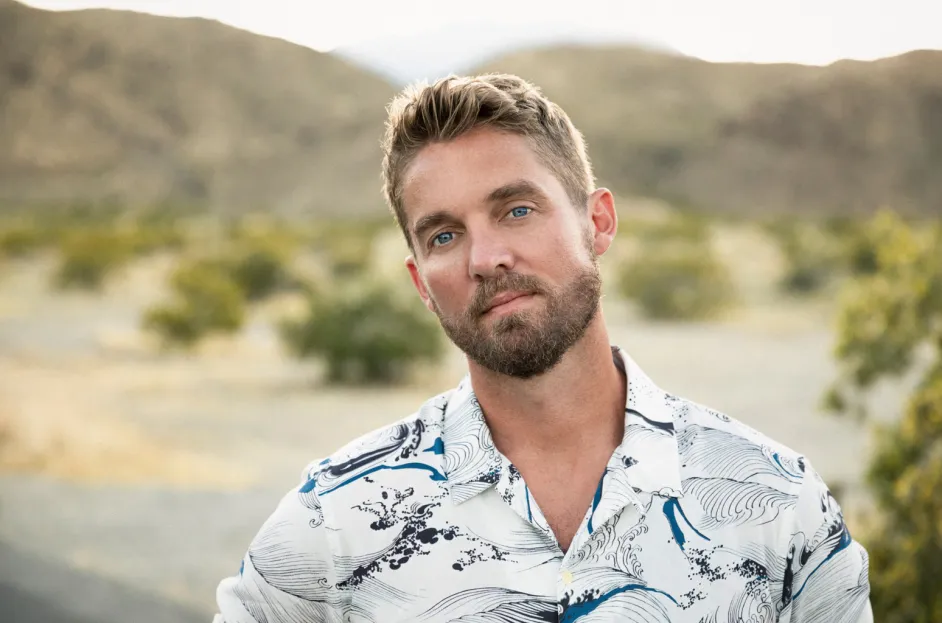
Picture of Brett Young - Photo by Seth Kupersmith - Maverick

Brett Young’s ‘2.0’

Brett Young’s 2.0 refines his signature romantic country-pop with a slightly bolder energy. The album blends familiar heartfelt ballads with more up-tempo, arena-ready moments, featuring collaborations with Lady A and George Birge. Smooth vocals, polished production, and concise songwriting keep it accessible, if predictable at times. Young’s strength lies in his ability to craft earnest love songs that resonate without overcomplicating them. While it doesn’t break much new ground stylistically, 2.0 maintains his emotional appeal and delivers a reliable, polished collection of tracks for fans of contemporary country-pop. A confident, if conservative, addition to his catalogue. To read the full article, see our last issue here. Never miss a story… Follow us on: Instagram: @Maverick.mag Twitter: @Maverick_mag Facebook: Maverick Magazine Media Contact Editor, Maverick Magazine Tel: +44 (0) 1622 823 920 Email: editor@maverick-country.com

Brett Young’s ‘2.0’ Read More »

Picture of Lainey Wilson - Photo by Alex Berger - Maverick

Lainey Wilson’s “Somewhere Over Laredo”

Lainey Wilson’s “Somewhere Over Laredo” blends cinematic flair with her signature gritty vocal delivery. Borrowing melodic elements from “Over the Rainbow”, the song reimagines familiar country tropes with theatrical scale and emotional charge. It’s a sweeping ballad layered with lush instrumentation and dynamic builds, capturing her growing confidence as a storyteller. The production feels grand yet grounded, and her vocal performance carries both strength and vulnerability. As the lead single from the deluxe edition of Whirlwind, it underscores Wilson’s knack for blending tradition and boldness, offering a memorable, ambitious addition to her repertoire that highlights her creative evolution. To read the full article, see our last issue here. Never miss a story… Follow us on: Instagram: @Maverick.mag Twitter: @Maverick_mag Facebook: Maverick Magazine Media Contact Editor, Maverick Magazine Tel: +44 (0) 1622 823 920 Email: editor@maverick-country.com

Lainey Wilson’s “Somewhere Over Laredo” Read More »

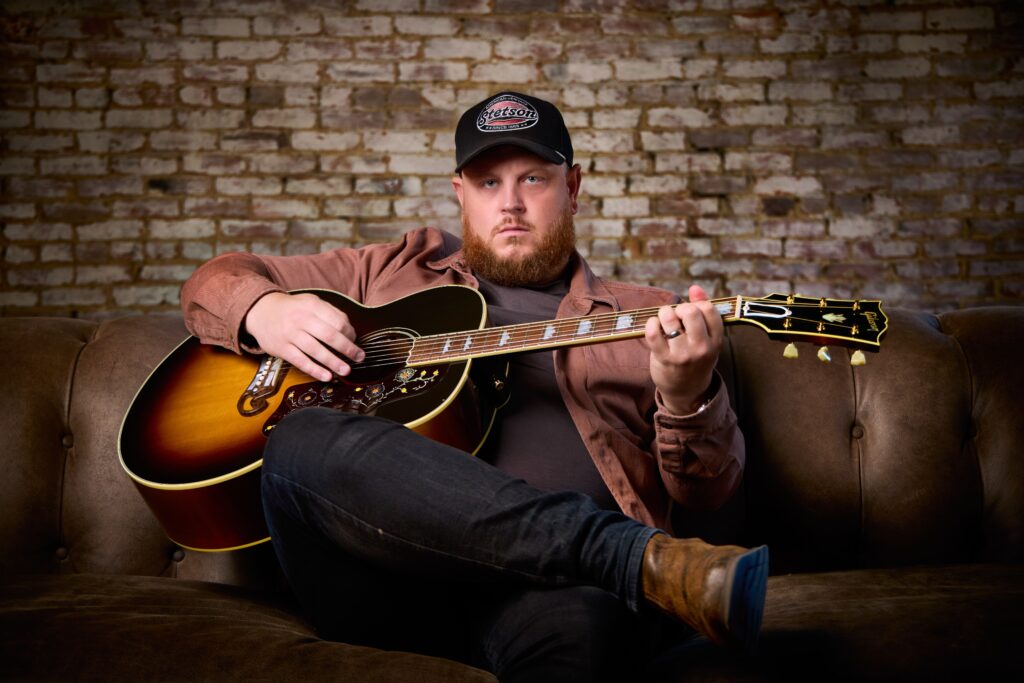
Picture of Liam Price - PR photo - Maverick

Liam Price’s The Grass Ain’t Green

Liam Price, whose voice will be recognised by many from the Luke Combs UK Tribute, delivers a raw, confessional ballad exploring regret, relapse, and the rocky road to redemption with “The Grass Ain’t Green.” Set against imagery of isolation, drinking, and self-reckoning, it captures the ache of realising that escape doesn’t guarantee clarity. The recurring line “I can’t see the wood for the trees” sharply illustrates emotional disorientation. With its cyclical chorus and emotional honesty, the song reflects a remarkably self-aware young artist wrestling with pain, accountability, and the hard-earned wisdom of hindsight.  To read the full article, see our last issue here. Never miss a story… Follow us on: Instagram: @Maverick.mag Twitter: @Maverick_mag Facebook: Maverick Magazine Media Contact Editor, Maverick Magazine Tel: +44 (0) 1622 823 920 Email: editor@maverick-country.com

Liam Price’s The Grass Ain’t Green Read More »

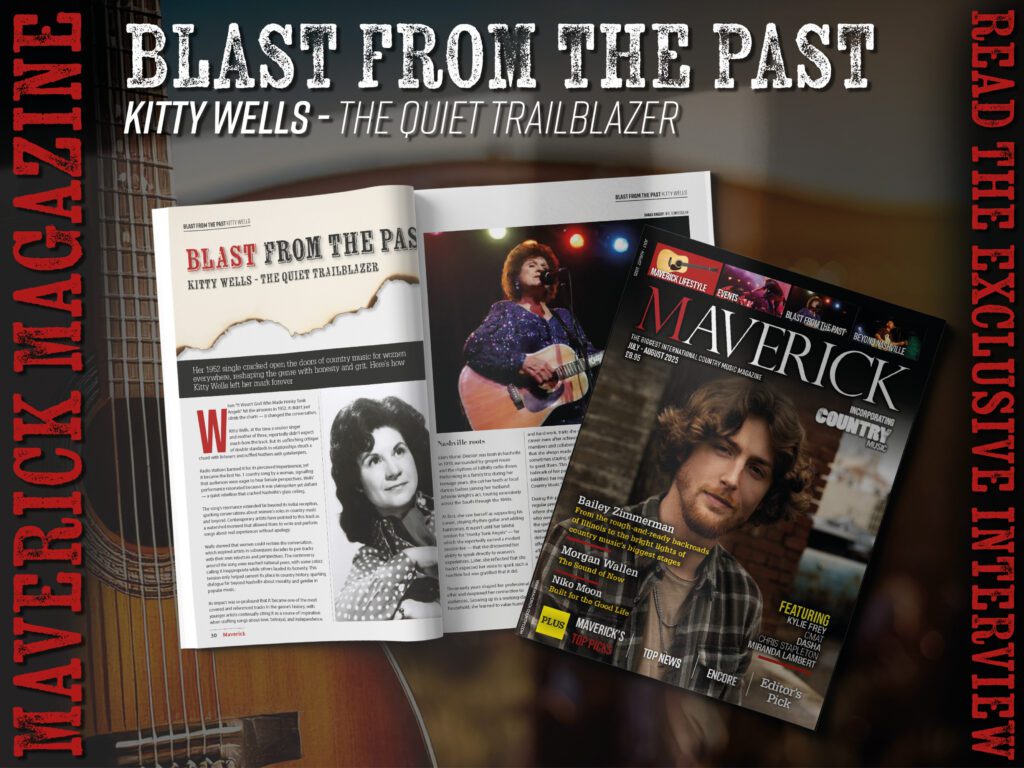
Blast from the Past - Maverick-country.com

The Quiet Trailblazer – How Kitty Wells Redefined Country Music

Her 1952 single cracked open the doors of country music for women, reshaping the genre with honesty and grit. Here’s how Kitty Wells left her mark forever. When “It Wasn’t God Who Made Honky Tonk Angels” hit the airwaves in 1952, it didn’t just climb the charts — it changed the conversation. Kitty Wells, at the time a session singer and mother of three, reportedly didn’t expect much from the track. But its unflinching critique of double standards in relationships struck a chord with listeners and ruffled feathers with gatekeepers. Radio stations banned it for its perceived impertinence, yet it became the first No. 1 country song by a woman, signalling that audiences were eager to hear female perspectives. Wells’ performance resonated because it was plainspoken yet defiant — a quiet rebellion that cracked Nashville’s glass ceiling. The song’s resonance extended far beyond its initial reception, sparking conversations about women’s roles in country music and beyond. Contemporary artists have pointed to this track as a watershed moment that allowed them to write and perform songs about real experiences without apology. Wells showed that women could reclaim the conversation, which inspired artists in subsequent decades to pen tracks with their own rebuttals and perspectives. The controversy around the song even reached national press, with some critics calling it inappropriate while others lauded its honesty. This tension only helped cement its place in country history, sparking dialogue far beyond Nashville about morality and gender in popular music. Its impact was so profound that it became one of the most covered and referenced tracks in the genre’s history, with younger artists continually citing it as a source of inspiration when crafting songs about love, betrayal, and independence. Ellen Muriel Deason was born in Nashville in 1919, surrounded by gospel music and the rhythms of hillbilly radio shows. Performing in a family trio during her teenage years, she cut her teeth at local dances before joining her husband Johnnie Wright’s act, touring extensively across the South through the 1940s. At first, she saw herself as supporting his career, playing rhythm guitar and adding harmonies. It wasn’t until her fateful session for “Honky Tonk Angels” — for which she reportedly earned a modest session fee — that she discovered her ability to speak directly to women’s experiences. Later, she reflected that she hadn’t expected her voice to spark such a reaction but was gratified that it did. Those early years shaped her professional ethic and deepened her connection to audiences. Growing up in a working-class household, she learned to value humility and hard work, traits she carried into her career even after achieving fame. Family members and collaborators later noted that she always made time for her fans, sometimes staying after shows for hours to greet them. This accessibility became a hallmark of her public persona and further solidified her reputation as “The Queen of Country Music.” To read the full article, see our last issue here. Never miss a story… Follow us on: Instagram: @Maverick.mag Twitter: @Maverick_mag Facebook: Maverick Magazine Media Contact Editor, Maverick Magazine Tel: +44 (0) 1622 823 920 Email: editor@maverick-country.com

The Quiet Trailblazer – How Kitty Wells Redefined Country Music Read More »

Picture of CMAT - Photo by Caitlin Devlin - Maverick

CMAT – Country at the Fringes

With humour, heartbreak and theatrical defiance, CMAT has built a cult following at the edge of country-pop — and now, the world is finally catching on. At Glastonbury 2025, CMAT arrived dressed like a rodeo pop star from another planet—sequins blazing, fringe flying, boots planted, and voice unwavering. The Pyramid Stage crowd didn’t just watch her—they leaned in. It was the kind of moment that feels inevitable only after it happens: Ciara Mary-Alice Thompson, known to fans simply as CMAT, commanding the biggest platform in British music, still singing about heartbreak, hangovers, and the strange ache of being alive. She didn’t explode onto the scene so much as orbit it, waiting for the industry to catch up. And now, with her third album on the way and her live show fast becoming legend, CMAT stands precisely where she’s always said she belonged: on the edge of things, shining. CMAT’s story is too winding for tidy mythology, but that’s part of the point. Raised in Dunboyne, County Meath, she grew up with a head full of melodies, a love for pop drama, and a taste for country melancholy. There was no musical dynasty or overnight discovery. Instead, there was a brief, bruising stint in Manchester with a now-defunct duo, a detour into retail, and a creative collapse that sent her back to Dublin. Her turning point wasn’t an audition or a co-sign. It was a slow return to herself, often documented on social media, where she blended vulnerable songwriting with grandiose humour. CMAT began uploading songs with titles that read like punchlines but landed like confessions. Her debut album, If My Wife New I’d Be Dead, became a cult classic on release in 2022. Beneath its camp and chaotic veneer was an artist meticulously crafting a voice that could hold both sorrow and absurdity. C<MA CMAT is often called a country artist, but the label doesn’t quite fit—and she knows it. She’s described her sound as “Euro-country” not just to signal its Irishness, but to reflect the genre’s displacement. Her country isn’t the dustbowl or the truck stop; it’s a karaoke bar at closing time, a night bus through Dublin’s outskirts, a voice memo at 3 a.m. trying to make sense of something already lost. The musical references range wide: Tammy Wynette, Charli XCX, Magnetic Fields, Meat Loaf. And while she’s drawn to Americana’s emotional directness, she delivers it with European surrealism. On stage and record, she’s melodramatic without irony, sincere without sentimentality. That contradiction is her power. Her lyrics feel like diary entries written in eyeliner, full of exes, epiphanies and the desperate attempts to make sense of feelings that won’t behave. If her voice occasionally cracks under the weight of what she’s singing, it only underscores her ability to make spectacle feel strangely intimate. To read the full article, see our last issue here. Never miss a story… Follow us on: Instagram: @Maverick.mag Twitter: @Maverick_mag Facebook: Maverick Magazine Media Contact Editor, Maverick Magazine Tel: +44 (0) 1622 823 920 Email: editor@maverick-country.com

CMAT – Country at the Fringes Read More »

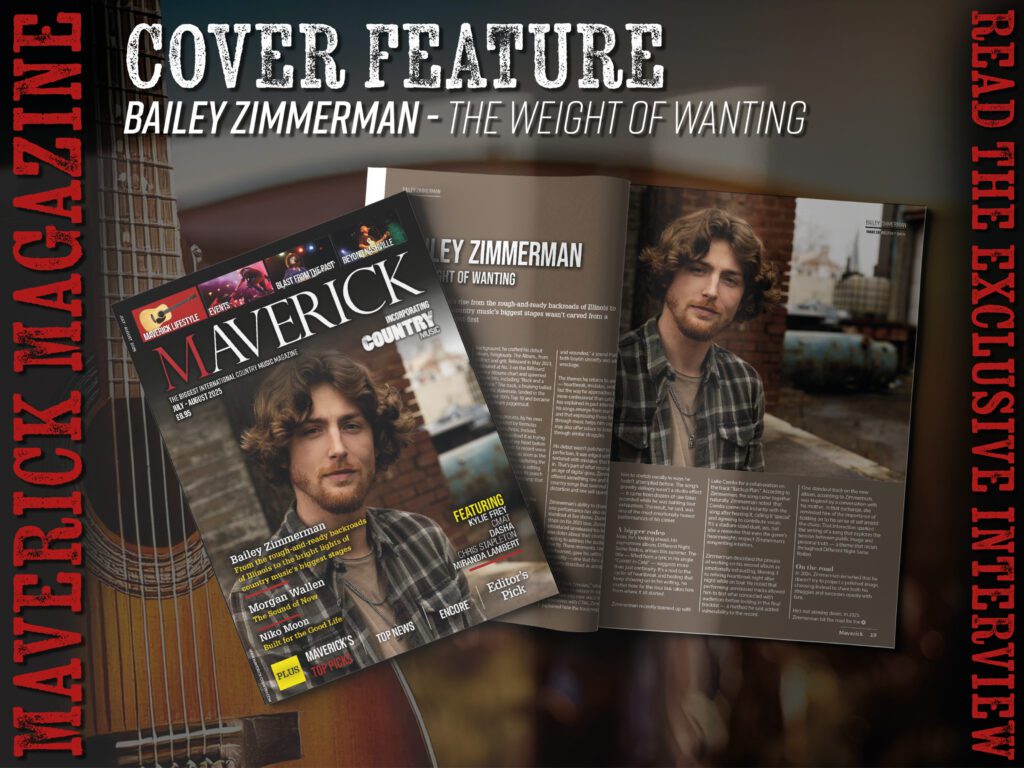
Bailey Zimmerman Cover - maverick-country.com

Bailey Zimmerman – The Weight of Wanting

Bailey Zimmerman’s rise from the rough-and-ready backroads of Illinois to the bright lights of country music’s biggest stages wasn’t carved from a blueprint — it came gut-first. With a voice like cracked leather and lyrics soaked in heartbreak, Bailey Zimmerman has bulldozed his way into the genre’s core without ever losing sight of what set him apart: the honesty, the ache, and the gravel in his gut. Heavy boots on fresh concrete. That’s the feeling you get listening to Bailey Zimmerman. There’s momentum in his music — not just in the number of streams or tour dates, but in the way his songs drive forward, heavy-hearted and unrelenting. Even when they ache, they move. And movement, for Zimmerman, has never been optional. Long before he became a country chart staple, Zimmerman was working on gas pipelines and posting truck cab videos on TikTok. Raised in small-town Louisville, Illinois, he’d clock a full day on the job before singing straight into his phone. It wasn’t a marketing strategy — it was a release. As he once revealed, he thought he was going to build gas pipelines for the rest of his life. Instead, one of those videos — a raw vocal run on a song that would become “Fall In Love” — caught fire. And in 2022, the heartbreak anthem shot to No. 1 on the Country Airplay charts, making him the fastest debut artist to top that chart in seven years. Zimmerman’s rise was fast, but not fluked. With no formal music background, he crafted his debut album, Religiously. The Album., from instinct and grit. Released in May 2023, it debuted at No. 3 on the Billboard Country Albums chart and spawned multiple hits, including “Rock and a Hard Place.” The track, a bruising ballad of romantic stalemate, landed in the Billboard Hot 100’s Top 10 and became a multi-platinum juggernaut. His songwriting process, by his own account, isn’t guided by formulas or co-writing workshops. Instead, Zimmerman has described it as trying to get the truth out of my head before it chokes him. He tends to record voice memos and rough takes as soon as the emotion hits, sometimes capturing the chorus before the story has a setting. This rawness gives his music its punch — a kind of emotional timestamp that hasn’t been buffed smooth. Zimmerman has credited artists like Morgan Wallen and Post Malone with helping him find a voice that could carry both country grit and contemporary urgency. He’s said that genre lines don’t interest him as much as emotional clarity, and that what matters is whether a song feels honest enough to hurt. That outlook has shaped his blend of country, rock and modern pop, helping him carve a lane that resists pigeonholing. To read the full article, see our last issue here. Never miss a story… Follow us on: Instagram: @Maverick.mag Twitter: @Maverick_mag Facebook: Maverick Magazine Media Contact Editor, Maverick Magazine Tel: +44 (0) 1622 823 920 Email: editor@maverick-country.com

Bailey Zimmerman – The Weight of Wanting Read More »

Scroll to Top