Exclusives

Brooks & Dunn - maverick-country.com

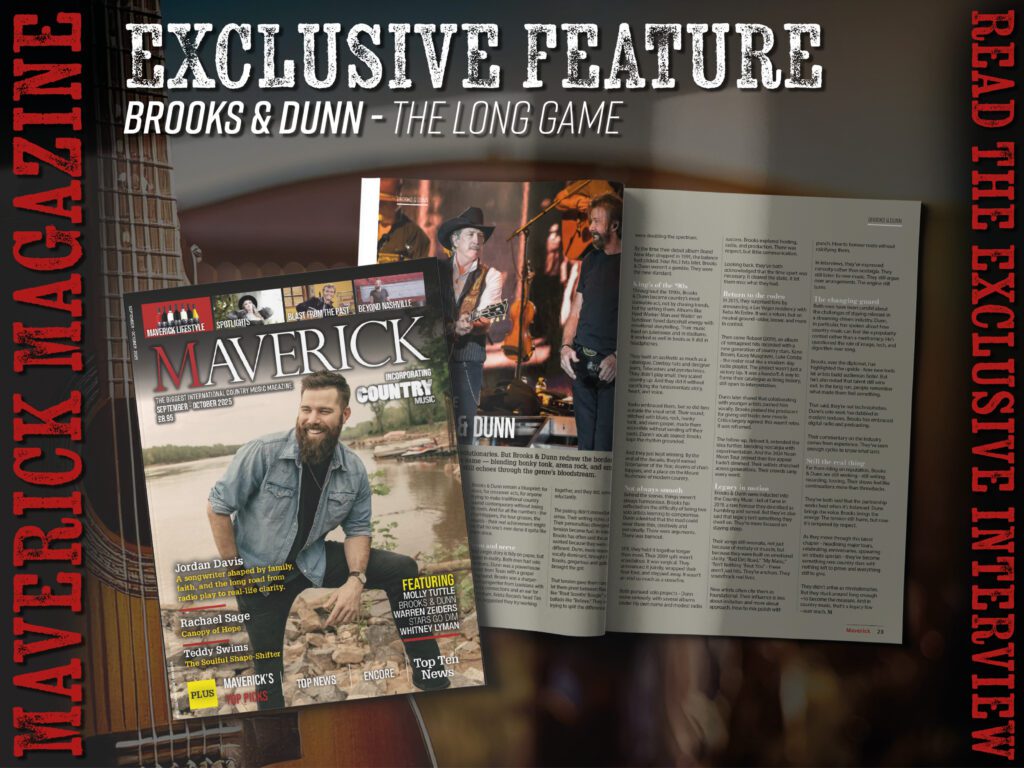
Brooks & Dunn – The Long Game

They didn’t arrive as revolutionaries. But Brooks & Dunn redrew the borderlines of country music just the same — blending honky tonk, arena rock, and emotional clarity into a sound that still echoes through the genre’s bloodstream. When Brooks & Dunn reunited in 2015 after a five-year hiatus, it wasn’t out of necessity. They had nothing left to prove. Already Country Music Hall of Famers, with more CMA Awards than any other duo in history, they could’ve stayed gone — proud, platinum, and preserved. But Kix Brooks and Ronnie Dunn were never interested in legacy as museum piece. Their return wasn’t nostalgic. It was purposeful. A reminder that the sharpest tools in country’s box were far from relics, they still had an edge. Three decades after their 1991 debut, Brooks & Dunn remain a blueprint: for duos, for crossover acts, for anyone trying to make traditional country sound contemporary without losing its roots. And for all the numbers — the chart-toppers, the tour grosses, the awards — their real achievement might be that no one’s ever done it quite like them since. Their origin story is tidy on paper, but jagged in reality. Both men had solo ambitions. Dunn was a powerhouse vocalist from Texas with a gospel background. Brooks was a sharper-edged songwriter from Louisiana with industry connections and an ear for momentum. Arista Records head Tim DuBois suggested they try working together, and they did, somewhat reluctantly. The pairing didn’t immediately make sense. Their writing styles clashed. Their personalities diverged. But the tension became fuel. In interviews, Brooks has often said the act only worked because they were so different. Dunn, more reserved and vocally dominant, brought the ache. Brooks, gregarious and guitar-forward, brought the grit. That tension gave them range. It let them pivot between floor-fillers like “Boot Scootin’ Boogie” and ballads like “Believe.” They weren’t trying to split the difference, they were doubling the spectrum. By the time their debut album Brand New Man dropped in 1991, the balance had clicked. Four No.1 hits later, Brooks & Dunn weren’t a gamble. They were the new standard. Throughout the 1990s, Brooks & Dunn became country’s most bankable act, not by chasing trends, but by setting them. Albums like Hard Workin’ Man and Waitin’ on Sundown fused dancehall energy with emotional storytelling. Their music lived on jukeboxes and in stadiums. It worked as well in boots as it did in headphones. They built an aesthetic as much as a catalogue. Cowboy hats and designer jeans, Telecasters and pyrotechnics. They didn’t play small, they scaled country up. And they did it without sacrificing the fundamentals: story, heart, and voice. Radio embraced them, but so did fans outside the usual orbit. Their sound, stitched with blues, rock, honky tonk, and even gospel, made them accessible without sanding off their roots. Dunn’s vocals soared; Brooks kept the rhythm grounded. And they just kept winning. By the end of the decade, they’d earned Entertainer of the Year, dozens of chart-toppers, and a place on the Mount Rushmore of modern country. To read the full article, see our last issue here. Never miss a story… Follow us on: Instagram: @Maverick.mag Twitter: @Maverick_mag Facebook: Maverick Magazine Media Contact Editor, Maverick Magazine Tel: +44 (0) 1622 823 920 Email: editor@maverick-country.com

Brooks & Dunn – The Long Game Read More »
Molly tuttle - maverick-country.com

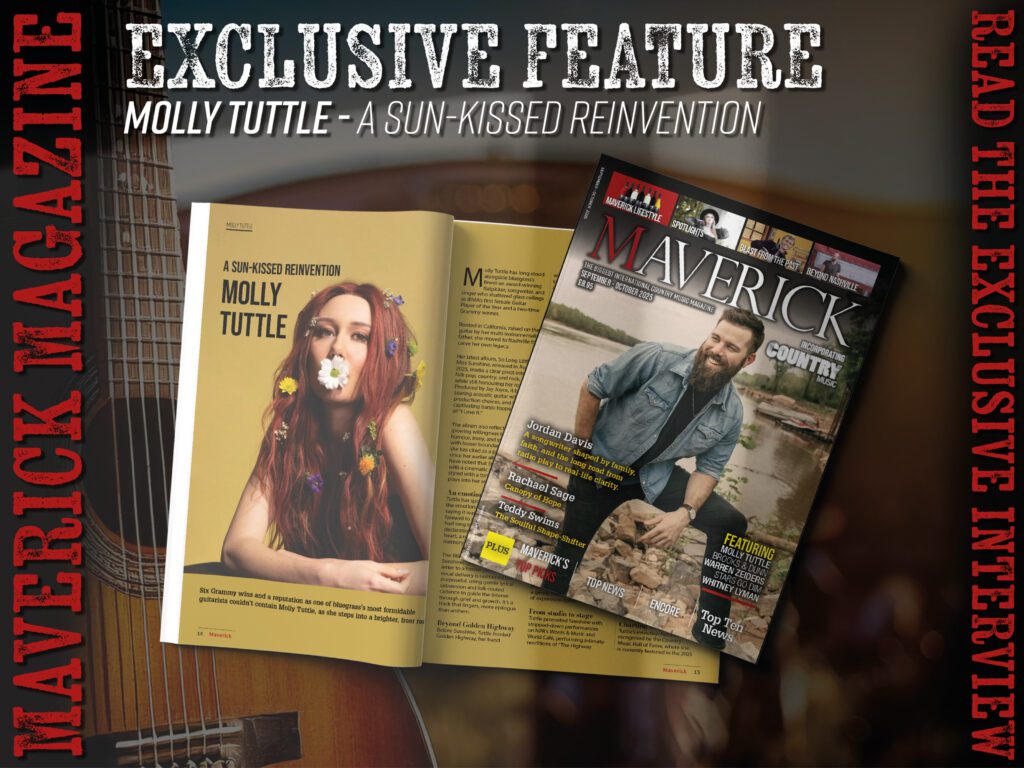
Molly Tuttle: A Sun-Kissed Reinvention

Six Grammy wins and a reputation as one of bluegrass’s most formidable guitarists couldn’t contain Molly Tuttle, as she steps into a brighter, freer realm   Molly Tuttle has long stood alongside bluegrass’s finest-an award‑winning flatpicker, songwriter, and singer who shattered glass ceilings as IBMA’s first female Guitar Player of the Year and a two‑time Grammy winner.    Rooted in California, raised on the guitar by her multi‑instrumentalist father, she moved to Nashville to carve her own legacy.   Her latest album, So Long Little Miss Sunshine, released in August 2025, marks a clear pivot-into folk‑pop, country, and rock, while still honouring her roots.  Produced by Jay Joyce, it blends soaring acoustic guitar with bold production choices, and includes a captivating banjo‑topped rendition of “I Love It.”    The album also reflects Tuttle’s growing willingness to incorporate humour, irony, and storytelling with looser boundaries, something she has cited as a personal goal since her earlier albums. Critics have noted that Sunshine moves with a cinematic quality, each track styled with a tone or colour that plays into her evolving self-image.   An emotional shift   Tuttle has spoken candidly about the emotional shift in this album, saying it was about bidding farewell to a version of herself that had long tried to blend in. That declaration captures the record’s heart, a reckoning with identity, memory, and creative direction.   The title track, “So Long Little Miss Sunshine,” plays like a farewell letter to a former persona. Tuttle’s vocal delivery is restrained but purposeful, using gentle lyrical subversion and folk-rooted cadence to guide the listener through grief and growth. It’s a track that lingers, more epilogue than anthem.   Beyond Golden Highway   Before Sunshine, Tuttle fronted Golden Highway, her band with whom she released two consecutive Grammy‑winning albums (Crooked Tree and City of Gold). But in May 2025, she announced that Golden Highway would step back, freeing space for a new ensemble designed to suit this album’s evolving sound.   That shift wasn’t easy: Golden Highway had been more than a band-it was a family, musical collaborators, and the backbone of her sound. The transformation speaks to Tuttle’s resolve to grow, even when that means relinquishing comfort zones.   On the creative front, Molly describes experiencing a spark between her roots and newer influences, writing songs that straddled two worlds.  She began with tracks that felt more contemporary and personal, then found her bluegrass senses reawakening mid‑project. She chose to record with Jay Joyce in Nashville, drawn to his ability to blend textures across genres.   The album cover, designed by Tuttle herself, captures that tension visually, featuring multiple versions of Molly wearing different wigs. It’s a playful emblem of shedding expectations and embracing the many shades of identity. In a recent media profile, she explained feeling grateful for where she is now, even if the path wasn’t always straightforward… Read the full article here. 

Molly Tuttle: A Sun-Kissed Reinvention Read More »

Warren Zeiders - maverick-country.com

Warren Zeiders: Edge of Anthem

Warren Zeiders brings lacrosse determination and storytelling candour to country’s frontier—viral hits, relentless drive and emotional honesty assemble into a new paradigm of success  In the hush of a drop‑lit stage, Warren Zeiders embodies transition—not just of sound, but of identity.   Born in Hershey, Pennsylvania, the former college lacrosse player spent twelve years chasing a ball before a snapped dream became his greatest pivot.   Music swept in not as plan B, but as inevitability. In previous interviews he’s explained that if he cares about something and invests himself fully into it, nothing will stop him, reflecting that same athletic hunger now rechanneled into song.  He began building a following by sharing cover videos on TikTok while completing a business degree at Frostburg State University.   Zeiders recorded in his dorm room until “Ride the Lightning” exploded online, a rough‑hewn anthem of love and escape that racked up over 500 million views, earned platinum status in the U.S. and Canada, and marked the arrival of a raw, unfiltered new artist.  Romantic soul  His rise was meteoric yet grounded, leading to Acoustic Covers, a 2021 debut that merged Tyler Childers solemnity with Lynyrd Skynyrd swagger, all filtered through gritty vocals.   That path led to Warner Records, 717 Tapes the Album in 2022 and then to his breakthrough: Pretty Little Poison, released August 2023. The title track, a rush of heart‑ache disguised as a drug metaphor, went to No 1 on country radio, making Zeiders country music’s neatest breakout since Nate Smith.   His sound balances outsider rock—think Nickelback energy—with the ache of a slow‑burn ballad that refuses to let go.  Zeiders followed up with Relapse (2024), a lean, moody record produced by Mike Elizondo and Ross Copperman. Singles like “Addictions” and the brooding title track introduced a darker tone, confirmed in the double‑album Relapse, Lies & Betrayal in March.  Its tracklist is as confessional as it is ambitious, with Billboard capturing Zeiders at his most unguarded, shaking off a raw, living pain.  Tough Love  When Zeiders first toured Europe, he was amazed by fans knowing every lyric despite his being unknown years before—a humbling reminder of how far he’s come.   Critics describe his stage presence as athletic: each performance feels rehearsed yet urgent, like controlled chaos enhanced by grit.  Seeking to play stadiums, Zeiders himself has said he isn’t afraid to show the edge in his performances, nor to declare his ambition to one day fill arenas with roaring crowds  Discipline as devotion  In interviews, Zeiders has underscored how his athletic past shaped his professional ethos, likening his touring schedule to a training regimen: disciplined, strategic, and always forward-moving. He cites motivational figures like Tom Brady, David Goggins, and Kobe Bryant as technicolour influences on his commitment to relentless improvement.   Far from an opportunity for breaks and downtime, he uses time on the road as a purposeful rehearsal for the next set. Zeiders treats touring like prepping for a championship, leaning on structure even when away from home. His follow-up to a show isn’t partying; it’s watching Netflix or Dune Part Two with his team to distil visual ideas for upcoming videos and stage design.   His local success at the Morgan County Fair, headlining crowds after only a few releases, underscored that foundation. He described “Pretty Little Poison” as an anthem to destructive attraction, calling it “like a moth to a flame,” a preference for what hurts with magnetic pull…. Read the full article here. 

Warren Zeiders: Edge of Anthem Read More »

Blast from the Past - Maverick-country.com

Jerry Reed: The Guitar Man

From deep-fried licks to genre-bending stardom, Jerry Reed redefined the rules of country music—armed with a grin, a guitar, and a whole lot of groove   By the time Jerry Reed passed away in 2008 at the age of 71, he’d long since burned his silhouette into the side of country music. A guitarist, songwriter, singer, and scene-stealing actor, Reed defied easy categorisation. He could fingerpick with the best of them, pen hits for Elvis Presley, turn corny turns of phrase into gold, and still find time to become a pop culture fixture in his own right.   Born in Atlanta, Georgia, in 1937, Reed’s earliest years were shaped by more than music; they were forged by turmoil and displacement. After his parents separated when he was just four months old, Reed and his sister spent seven formative years in foster homes and orphanages before rejoining their mother and stepfather in 1944.    Even in those difficult circumstances, music offered Reed solace. He began playing guitar as a child in Atlanta, teaching himself chords and absorbing the sounds around him. By his mid‑teens, he was already writing songs and performing locally, eventually earning his first break at age 18 with a deal from publisher Bill Lowery.   High school at O’Keefe in Atlanta proved pivotal. Reed wasn’t merely consuming country or gospel records, he was experimenting. He sang, wrote, played, and dreamed aloud. Sometime around this period, he left high school in 1955 to pursue music full‑time, recording rockabilly and country singles for Capitol Records, songs like “When I Found You.” That early leap, leaving conventional security behind, would prefigure the rest of his career: bold, unfettered, genre‑defying.   A Pickin’ Phenomenon   It wasn’t until the mid-1960s, after a stint in the army and a move to Nashville, that Reed’s style fully bloomed. Working as a session guitarist, he quickly became known for his lightning-fast, syncopated fingerpicking, a style he dubbed “claw style,” inspired by banjo rolls but entirely his own.   The studio elite took notice. Reed became a go-to guitarist for producer Chet Atkins, who famously described him as “a genius,” and said there was no one else who could play quite like him.   That wasn’t just flattery. Reed’s guitar playing danced outside the lines—groovy, rubbery, almost funky in its phrasing. It helped usher in a freer approach to country instrumentation at a time when the Nashville Sound threatened to smooth everything into syrup.   In 1967, Reed’s instrumental “The Claw” turned heads in guitar circles. But it was the following year’s Nashville Underground that captured broader attention. With it, Reed essentially laid the groundwork for a more genre-bending brand of country—equal parts Southern soul, swamp funk, and rockabilly twang.   The album title itself was a winking nod to his outlier status—“underground” in attitude if not sales—and its blend of instrumentals and vocal tracks became a cult favourite among session players and young Nashville rebels alike.   He also became a bridge between two musical generations: a studio veteran who could sit in with the old guard, and a rhythmic innovator who attracted young players. His blend of precision and playfulness became a benchmark for what country guitar could aspire to, less twang and more twist, bending expectations as easily as strings.   His sessions during this period helped reshape the role of guitar in country music, from simple rhythm support to lead instrument with narrative presence. Artists who came after, like Ricky Skaggs and Marty Stuart, would credit this evolution to players like Reed, whose blend of rhythm and melody made the guitar speak as much as the lyrics.   The Elvis Connection   One of the most significant turning points in Reed’s career came when Elvis Presley recorded “Guitar Man,” (1967) a song Reed had written and released himself. Presley’s team wanted to recreate Reed’s distinct picking sound—and couldn’t. The King himself called Reed in to play on the session, and Reed delivered that unmistakable groove.   The success led to another Presley cut, “U.S. Male,” (1968) also penned by Reed, and opened the floodgates. Suddenly, Reed wasn’t just a sideman—he was a writer of hits, a player producers sought out, and a personality Nashville couldn’t ignore.   His songs for others and his own recordings both shared that quality: the ability to tell vivid stories (sometimes funny, sometimes mischievous, sometimes pointed) and to back those stories with a guitar style that made you feel the groove beneath the words.   Reed’s collaborations with Presley were also symbolic: they linked traditional country with rock and roll swagger. That crossover energy would later shape the sound of mainstream country itself, as more artists sought to straddle that same sonic border.   Funny, Fast, and Fearless   Reed’s solo career surged in the early 1970s with a string of hit singles that defied convention. “Amos Moses” (1970) was a rollicking, half-spoken swamp tale about a one-armed alligator hunter. “When You’re Hot, You’re Hot” (1971) was equal parts talking blues and funky country-fusion, complete with courtroom banter, and became Reed’s biggest country hit: spending five weeks at No. 1 on the Billboard Country chart and crossing into the Top 10 of the Hot 100 at No. 9.   These weren’t just novelty songs. Reed’s humour masked an inventiveness that shaped modern country storytelling. His phrasing, his unpredictable structures, and his sense of rhythm all bucked the norm. Even “She Got the Goldmine (I Got the Shaft)” in 1982, a comedic divorce anthem, became a No. 1 hit, a rarity for material so tongue-in-cheek.   Even on light-hearted songs, Reed displayed impeccable timing and structural precision, each verse landing with the punch of a well-set joke, but backed by complex musical phrasing that rewarded repeat listens.   Other charting curiosities include “Ko‑Ko Joe,” which reached No. 11 on the U.S. Country chart, adding another layer to his reputation as a songwriter who could marry comedic edge with musical craftsmanship.   Reed had figured out a secret: you didn’t have to choose between being a virtuoso and being entertaining. He could play with absolute precision, sing with comic timing, and still hold a room in the palm of his hand.   He was also a master of voice modulation, using spoken-word sections, exaggerated accents, and narrative pacing that made his songs feel like campfire stories. Many of today’s country entertainers, from Blake Shelton to Hardy, owe a debt to Reed’s

Jerry Reed: The Guitar Man Read More »

Teddy Swims - maverick-country.com

Teddy Swims: The Soulful Shape‑Shifter

Teddy Swims blends soul, country, and pop with emotional candour—turning vulnerability into power as he writes himself anew through heartache, fame and unexpected clarity   Underneath the soft glow of a solo spotlight, Teddy Swims, whose real name is Jaten Collin Dimsdale, exists in joyously unsettled musical territory.    He was never content to sit still in genre lanes: gospel, R&B, country, rock and pop swirl together in his songs, shaped by a childhood steeped in soul traditions.    Born in Conyers, Georgia, the grandson of a Pentecostal minister, Swims discovered his voice in high‑school musical theatre and became a YouTube phenomenon in 2019, posting covers of Shania Twain, Amy Winehouse and more. The “S” in his name—Someone Who Isn’t Me Sometimes—alludes to that fluid identity and the restless searching at his core.   Roots and resolve   Long before he became a streaming-era soul powerhouse, Swims’s musical education came piecemeal and personal. Raised in a tight-knit community, he credits his father with introducing him to classic soul and rock records—Al Green, Stevie Wonder, Queen. Meanwhile, his grandfather’s church provided an early platform for vocal experimentation, blending gospel fervour with theatrical projection.    High school was where it all clicked: after joining musical theatre, Swims developed a stage presence that matched his increasingly raw vocal power. As he later recalled, he never imagined the fame would come from covers, but the process of interpreting others’ pain helped him discover his own voice. That voice, weathered, elastic, and unmistakably human, has since become his calling card across genres.   That restless energy crystallised with Lose Control in 2023, a raw confession that ballooned into international consciousness. Peaking in the US top ten and celebrated across continents, the track propelled him toward mainstream pop stardom while keeping that blue‑collar beat of genuine feeling.   Following the song’s release, charts confirmed its unusual longevity. “Lose Control” climbed not just to US number one but remains one of the longest-charting songs on the Billboard Hot 100, a record that underlines Swims’s rare blend of emotional gut-punch and mass-market staying power.   In recent interviews, Swims has described Lose Control not merely as a hit but as therapy. It captured a moment of reckoning: a breakup, addiction, sleepless nights haunted by past shadows.   Raw emotion, refined sound   Swims’ debut album, I’ve Tried Everything but Therapy (Part 1), came in 2023, weaving introspection and healing through layered production across Los Angeles, Nashville and London. By early 2025, its sequel arrived—Part 2—offering diptychs in pain and recovery. Between these volumes, both vulnerability and artistry evolved.   The sequel leaned into brighter emotional territory. Featuring songs like Bad Dreams, Guilty, and Funeral, it reflected his emerging peace, and achieved No. 1 in Australia and Croatia, while landing him multiple charting spots across Europe and the US. It also carries a silver BPI certification in the UK.   “I wasn’t numbing anymore,” he said of writing Part 2, acknowledging the transformation from self‑destruction to self‑reflection, a shift he credits in part to therapy, love and the anticipation of fatherhood.   That turn toward healing was deliberate. Swims admitted he finally embraced professional help while working on his debut, encouraged by his partner, and later entered couples counselling to build a strong foundation for their new family. He has spoken about therapy becoming an essential tool, no less necessary than physical treatment, and used it to challenge stigma around mental health.   Bridging communities   On stage, Swims is part soul preacher, part pop star, part small‑town troubadour. His tours have taken him from headline arenas to intense festival crowds.    Notably, he halted a Brisbane show mid‑song when a scuffle broke out, reaffirming his “golden rules” of audience care and community. He invited a young boy onstage and resumed the set with sweeping emotion, a moment of warmth in the spotlight.   Between 2022 and 2025, Swims toured the world in support of his therapy project, following an earlier EP, Tough Love (2022), and headline performances that saw him open for Greta Van Fleet and tour internationally.   During his 2025 world tour in support of Part 2, Swims expanded into sweeping production upgrades, featuring new stage design and backing vocalists that elevated the live experience into “a whole new elevation and wonderful time,” according to touring insiders. Reviews of his June 2025 Red Rocks Amphitheatre show captured the emotional charge: fans were moved close to tears, his voice wrapping the audience in a warm, near-spiritual embrace. Observers noted how live settings had become vessels for shared emotional release—not spectacle, but communion.   All the while, Swims avoided fame’s mirror. Even at major awards shows, he stayed grounded. In a recent reflected moment, he acknowledged the potential for fame to spiral if it had come at a younger, less mature age, heeded as a warning against chasing buzz instead of being ready for consequence.   This summer, he’s embarked on the “I’ve Tried Everything but Therapy” world tour, with dates across North America, Europe, Australia, New Zealand, and the UAE. It includes landmark venues such as Red Rocks, Radio City Music Hall, Qudos Bank Arena, and a major set at the Isle of Wight Festival. Swim’s standing in the pantheon is assured, and growing.    Currents of influence   What sets Teddy Swims apart is his respectful disregard for category—one moment he channels Marvin Gaye or Otis Redding, the next he’s rooted in Americana sadness or pop clarity. He’s an artist who seems driven less by ambition than by necessity—to feel, to expose, to connect.   Reflecting on his rise, Swims acknowledged that early fame might have been his undoing. “If I’d had this success two years earlier”, he admitted, “I’d have put it straight to my liver.” Instead, he waited, enveloped in maturity, and arrived ready to hold himself accountable for his voice and his actions.   This wide dialogue across styles also extends to his artistry: Part 2 features collaborations with Giveon, Muni Long, Coco Jones, and GloRilla—voices from soul, R&B, and hip‑hop—affirming Swims’s willingness to share the space and blur genre borders.    He’s also been intentional about the sonic texture of his releases. Tracks like “The Door”—a 2024 single about escaping an abusive relationship—emerged as uplifts in airplay charts across Eastern Europe and the UK, extending his emotional reach while diversifying his stylistic palette….

Teddy Swims: The Soulful Shape‑Shifter Read More »

Jordan Davis - maverick-country.com

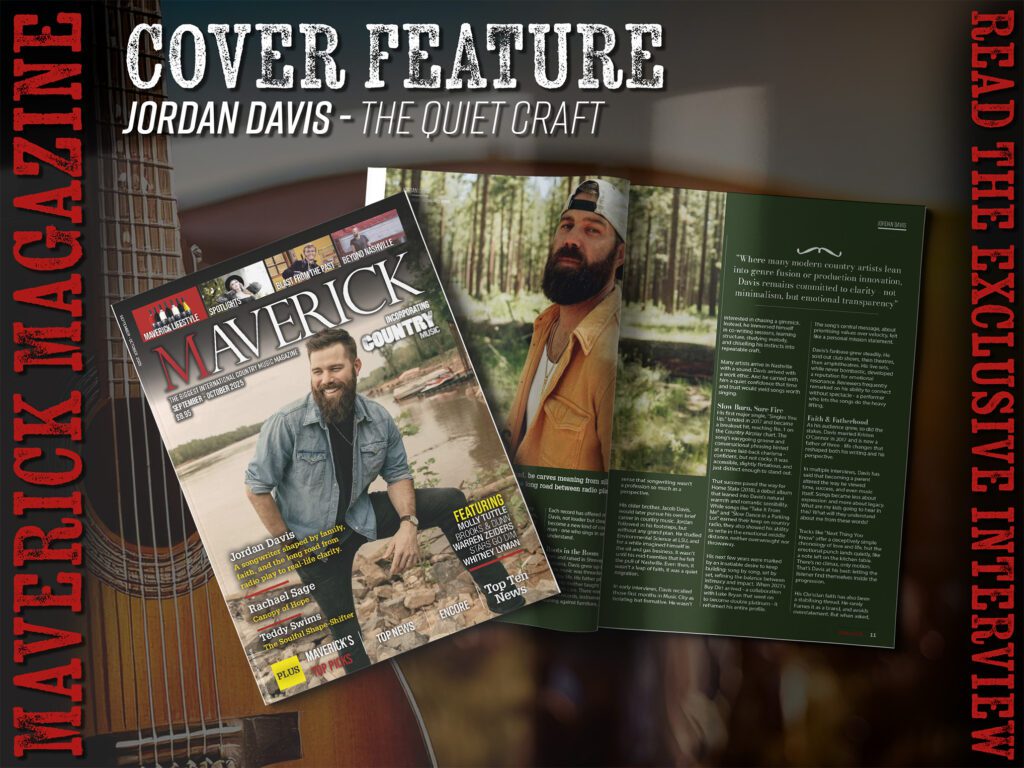
Jordan Davis – The Quiet Craft

Jordan Davis doesn’t shout to be heard. Instead, he carves meaning from silence – a songwriter grounded by family, faith, and the long road between radio play and real-life clarity   Jordan Davis never really looked like a disruptor. Clean-cut, quietly spoken, and thoughtful in the way he weighs his words, he entered country music with little fanfare and even less noise. But look closer, and what emerges isn’t absence, it’s precision.   In a genre often defined by flash, Davis has built his career on steadiness. His sound is smooth, but the stories underneath are not. His rise wasn’t meteoric, and his hits don’t explode, they unfurl. Over the past seven years, he’s become a fixture on country radio and festival stages, not by following the loudest trends, but by refining a songwriting voice that cuts quietly, carefully, and close to the bone.   His growth has been slow-burn but undeniable, from the toe-tap charm of Home State to the emotional detail of Bluebird Days and now the stripped-down honesty of Learned the Hard Way.   Each record has offered more of Davis, not louder but clearer. He’s become a new kind of country man – one who sings in order to understand.   Roots in the Room   Born and raised in Shreveport, Louisiana, Davis grew up in a house where music was threaded into everyday life. His father played guitar. His mother taught him to listen with care. There were hymns and old records, instruments leaning against furniture, and a sense that songwriting wasn’t a profession so much as a perspective.   His older brother, Jacob Davis, would later pursue his own brief career in country music. Jordan followed in his footsteps, but without any grand plan. He studied Environmental Science at LSU, and for a while imagined himself in the oil and gas business. It wasn’t until his mid-twenties that he felt the pull of Nashville. Even then, it wasn’t a leap of faith, it was a quiet migration.   In early interviews, Davis recalled those first months in Music City as isolating but formative. He wasn’t interested in chasing a gimmick. Instead, he immersed himself in co-writing sessions, learning structure, studying melody, and chiselling his instincts into repeatable craft.   Many artists arrive in Nashville with a sound. Davis arrived with a work ethic. And he carried with him a quiet confidence that time and trust would yield songs worth singing.   Slow Burn, Sure Fire   His first major single, “Singles You Up,” landed in 2017 and became a breakout hit, reaching No. 1 on the Country Airplay chart. The song’s easygoing groove and conversational phrasing hinted at a more laid-back charisma – confident, but not cocky. It was accessible, slightly flirtatious, and just distinct enough to stand out.   That success paved the way for Home State (2018), a debut album that leaned into Davis’s natural warmth and romantic sensibility. While songs like “Take It From Me” and “Slow Dance in a Parking Lot” earned their keep on country radio, they also showed his ability to write in the emotional middle distance, neither overwrought nor throwaway.   His next few years were marked by an insatiable desire to keep building: song by song, set by set, refining the balance between intimacy and impact. When 2021’s Buy Dirt arrived – a collaboration with Luke Bryan that went on to become double platinum – it reframed his entire profile.   The song’s central message, about prioritising values over velocity, felt like a personal mission statement… Read the full article here. 

Jordan Davis – The Quiet Craft Read More »

Stars Go Dim - maverick-country.com

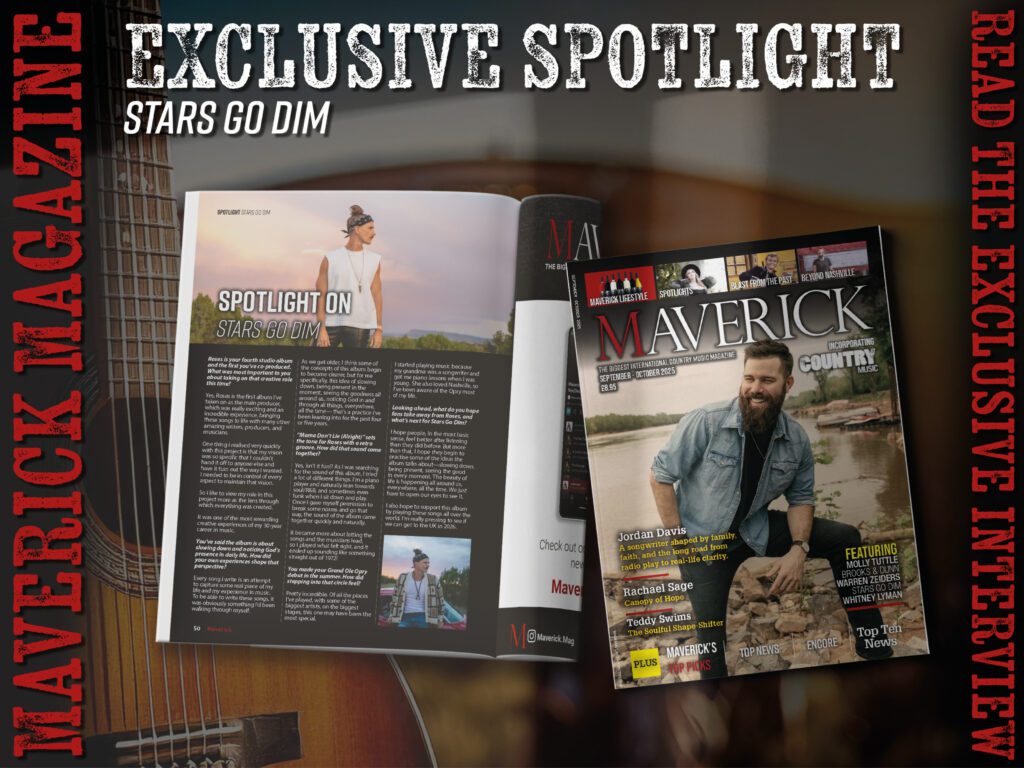
Artist Spotlight – Stars Go Dim

With a career spanning pop beginnings to Christian music milestones, Stars Go Dim continues to inspire by staying authentic, building hope, and letting the music speak for itself  Roses is your fourth studio album and the first you’ve co-produced. What was most important to you about taking on that creative role this time?  Yes, Roses is the first album I’ve taken on as the main producer, which was really exciting and an incredible experience, bringing these songs to life with many other amazing writers, producers, and musicians.  One thing I realised very quickly with this project is that my vision was so specific that I couldn’t hand it off to anyone else and have it turn out the way I wanted. I needed to be in control of every aspect to maintain that vision.  So I like to view my role in this project more as the lens through which everything was created.   It was one of the most rewarding creative experiences of my 30-year career in music.  You’ve said the album is about slowing down and noticing God’s presence in daily life. How did your own experiences shape that perspective?  Every song I write is an attempt to capture some real piece of my life and my experience in music. To be able to write these songs, it was obviously something I’d been walking through myself.  As we get older, I think some of the concepts of this album begin to become clearer, but for me specifically, this idea of slowing down, being present in the moment, seeing the goodness all around us, noticing God in and through all things, everywhere, all the time— that’s a practice I’ve been leaning into for the past four or five years.  “Mama Don’t Lie (Alright)” sets the tone for Roses with a retro groove. How did that sound come together?  Yes, isn’t it fun!? As I was searching for the sound of this album, I tried a lot of different things. I’m a piano player and naturally lean towards soul/R&B, and sometimes even funk when I sit down and play. Once I gave myself permission to break some norms and go that way, the sound of the album came together quickly and naturally.  It became more about letting the songs and the musicians lead, so I played what felt right, and it ended up sounding like something straight out of 1972!  You made your Grand Ole Opry debut in the summer. How did stepping into that circle feel?  Pretty incredible. Of all the places I’ve played, with some of the biggest artists, on the biggest stages, this one may have been the most special.  I started playing music because my grandma was a songwriter and got me piano lessons when I was young. She also loved Nashville, so I’ve been aware of the Opry most of my life.  Looking ahead, what do you hope fans take away from Roses, and what’s next for Stars Go Dim?  I hope people, in the most basic sense, feel better after listening than they did before. But more than that, I hope they begin to practise some of the ideas the album talks about—slowing down, being present, seeing the good in every moment. The beauty of life is happening all around us, everywhere, all the time. We just have to open our eyes to see it.  I also hope to support this album by playing these songs all over the world. I’m really pressing to see if we can get to the UK in 2026. 

Artist Spotlight – Stars Go Dim Read More »

Johnson & Finnemore - maverick-country.com

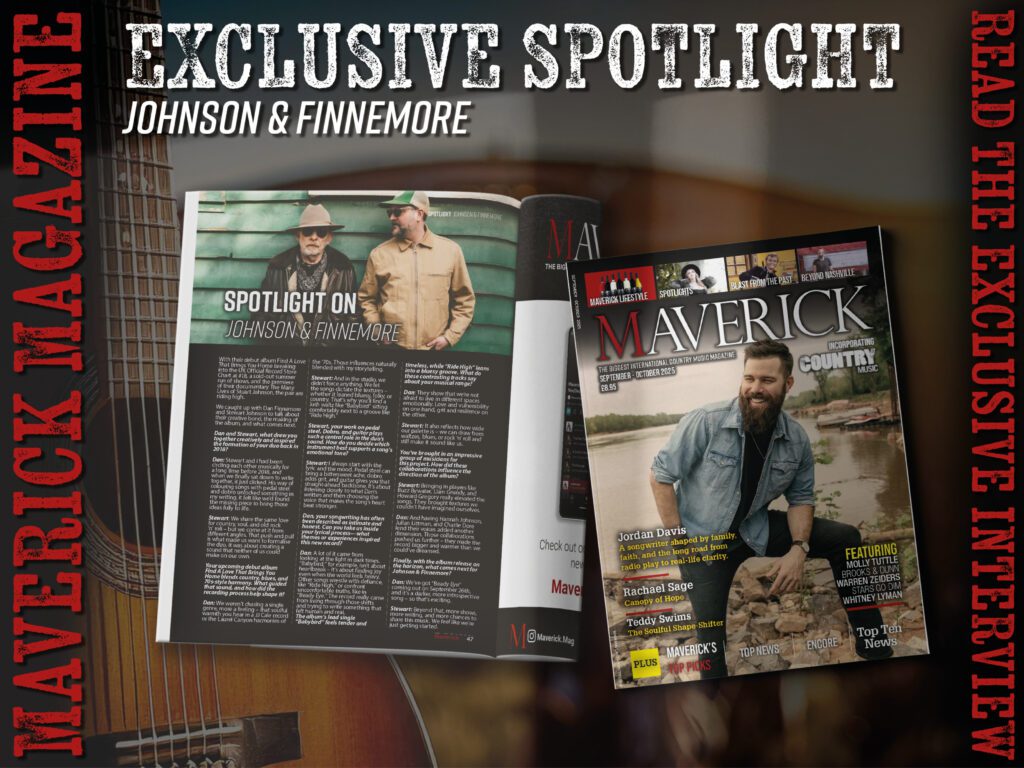
Americana Spotlight – Johnson & Finnemore

Rising Birmingham duo Johnson & Finnemore have been turning heads in the UK Americana scene with their soulful blend of country, blues, and Laurel Canyon-inspired harmony   With their debut album Find A Love That Brings You Home breaking into the UK Official Record Store Chart at #18, a sold-out summer run of shows, and the premiere of their documentary The Many Lives of Stuart Johnson, the pair are riding high.    We caught up with Dan Finnemore and Stewart Johnson to talk about their creative bond, the making of the album, and what comes next.   Dan and Stewart, what drew you together creatively and inspired the formation of your duo back in 2018?   Dan: Stewart and I had been circling each other musically for a long time before 2018, and when we finally sat down to write together, it just clicked. His way of colouring songs with pedal steel and dobro unlocked something in my writing. It felt like we’d found the missing piece to bring those ideas fully to life.  Stewart: We share the same love for country, soul, and old rock ’n’ roll – but we come at it from different angles. That push and pull is what made us want to formalise the duo. It was about creating a sound that neither of us could make on our own.   Your upcoming debut album Find A Love That Brings You Home blends country, blues, and 70s-style harmony. What guided that sound, and how did the recording process help shape it?  Dan: We weren’t chasing a single genre, more a feeling – that soulful warmth you hear in a JJ Cale record or the Laurel Canyon harmonies of the ’70s. Those influences naturally blended with my storytelling.  Stewart: And in the studio, we didn’t force anything. We let the songs dictate the textures – whether it leaned bluesy, folky, or country. That’s why you’ll find a lush waltz like “Babybird” sitting comfortably next to a groove like “Ride High.”   Stewart, your work on pedal steel, Dobro, and guitar plays such a central role in the duo’s sound. How do you decide which instrument best supports a song’s emotional tone?  Stewart: I always start with the lyric and the mood. Pedal steel can bring a bittersweet ache, dobro adds grit, and guitar gives you that straight-ahead backbone. It’s about listening closely to what Dan’s written and then choosing the voice that makes the song’s heart beat stronger.   Dan, your songwriting has often been described as intimate and honest. Can you take us inside your lyrical process—what themes or experiences inspired this new record?  Dan: A lot of it came from looking at the light in dark times. “Babybird,” for example, isn’t about heartbreak – it’s about finding joy even when the world feels heavy. Other songs wrestle with defiance, like “Ride High,” or confront uncomfortable truths, like in “Beady Eye.” The record really came from living through those shifts and trying to write something that felt human and real.   The album’s lead single “Babybird” feels tender and timeless, while “Ride High” leans into a bluesy groove. What do these contrasting tracks say about your musical range?  Dan: They show that we’re not afraid to live in different spaces emotionally. Love and vulnerability on one hand, grit and resilience on the other.  Stewart: It also reflects how wide our palette is – we can draw from waltzes, blues, or rock ’n’ roll and still make it sound like us.   You’ve brought in an impressive group of musicians for this project. How did these collaborations influence the direction of the album?  Stewart: Bringing in players like Buzz Bywater, Liam Grundy, and Howard Gregory really elevated the songs. They brought textures we couldn’t have imagined ourselves.  Dan: And having Hannah Johnson, Julian Littman, and Charlie Dore lend their voices added another dimension. Those collaborations pushed us further – they made the record bigger and warmer than we could’ve dreamed.   Your individual musical histories bring different flavours to the table. How do you navigate those distinct styles when writing and arranging together?  Dan: We lean into them, not away. My natural space is in storytelling and melody, while Stewart’s is in shaping the soundscape. When you trust each other, those differences stop being obstacles and start being the magic.  Stewart: Exactly – it’s like a conversation. We meet in the middle and the songs become something that belongs to both of us.   You’ve released the album across digital, CD and vinyl formats. Why was it important to include physical releases at a time when streaming dominates?  Stewart: Physical music matters – holding a vinyl or a CD connects you to the art in a way streaming never can.  Dan: We wanted listeners to have that tactile experience, to sit with the record as a whole, not just skip through playlists. It felt essential for a debut like this.   Looking back on your respective careers, what would you say was a pivotal moment—either solo or together—when you felt a real shift or breakthrough?  Stewart: For me, the documentary The Many Lives of Stuart Johnson was a turning point. It tied together all the different threads of my musical life and gave context to what we’re doing now.  Dan: And seeing Find A Love That Brings You Home break into the UK Official Record Store Chart at #18 – that was huge. It told us people were really listening.   Finally, with the album release on the horizon, what comes next for Johnson & Finnemore?  Dan: We’ve got “Beady Eye” coming out on September 26th, and it’s a darker, more introspective song – so that’s exciting.  Stewart: Beyond that, more shows, more writing, and more chances to share this music. We feel like we’re just getting started. 

Americana Spotlight – Johnson & Finnemore Read More »

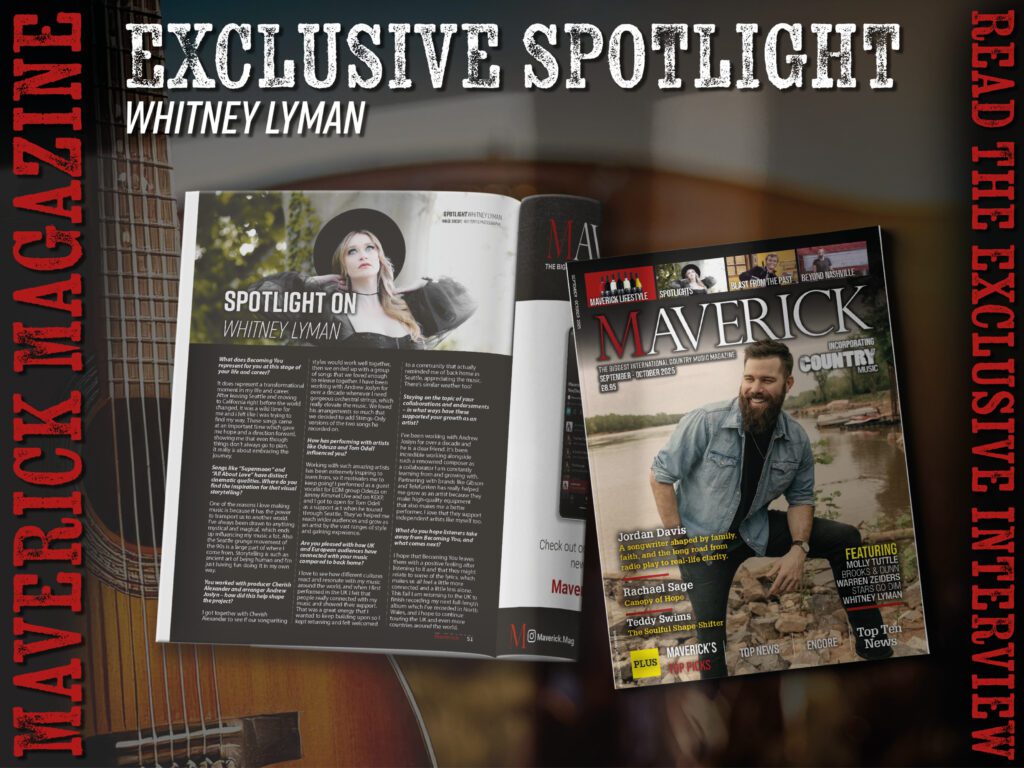
Artist Spotlight – Whitney Lyman

With her new EP Becoming You, Whitney Lyman blends Americana, indie rock, and cinematic pop into a journey of transformation, storytelling, and global connection  What does Becoming You represent for you at this stage of your life and career? Yes, it does represent a transformational moment in my life and career. After leaving Seattle and moving to California right before the world changed, it was a wild time for me and I felt like I was trying to find my way. These songs came at an important time which gave me hope and a direction forward, showing me that even though things don’t always go to plan, it really is about embracing the journey.  Songs like “Supermoon” and “All About Love” have distinct cinematic qualities. Where do you find the inspiration for that visual storytelling? One of the reasons I love making music is because it has the power to transport us to another world. I’ve always been drawn to anything mystical and magical, which ends up influencing my music a lot. Also the Seattle grunge movement of the 90s is a large part of where I come from. Storytelling is such an ancient art of being human and I’m just having fun doing it in my own way.  You worked with producer Cherish Alexander and arranger Andrew Joslyn – how did this help shape the project? I got together with Cherish Alexander to see if our songwriting styles would work well together, then we ended up with a group of songs that we loved enough to release together. I have been working with Andrew Joslyn for over a decade whenever I need gorgeous orchestral strings, which really elevate the music. We loved his arrangements so much that we decided to add Strings-Only versions of the two songs he recorded on.  How has performing with artists like Odesza and Tom Odell influenced you? Working with such amazing artists has been extremely inspiring to learn from, so it motivates me to keep going! I performed as a guest vocalist for EDM group Odesza on Jimmy Kimmel Live and on KEXP, and I got to open for Tom Odell as a support act when he toured through Seattle. They’ve helped me reach wider audiences and grow as an artist by the vast ranges of style and gaining experience.  Are you pleased with how UK and European audiences have connected with your music compared to back home? I love to see how different cultures react and resonate with my music around the world, and when I first performed in the UK I felt that people really connected with my music and showed their support. That was a great energy that I wanted to keep building upon so I kept returning and felt welcomed to a community that actually reminded me of back home in Seattle, appreciating the music. There’s similar weather too!  Staying on the topic of your collaborations and endorsements – in what ways have these supported your growth as an artist? I’ve been working with Andrew Joslyn for over a decade and he is a dear friend. It’s been incredible working alongside such a renowned composer as a collaborator I am constantly learning from and growing with. Partnering with brands like Gibson and Telefunken has really helped me grow as an artist because they make high-quality equipment that also makes me a better performer. I love that they support independent artists like myself too.  What do you hope listeners take away from Becoming You, and what comes next? I hope that Becoming You leaves them with a positive feeling after listening to it and that they might relate to some of the lyrics, which makes us all feel a little more connected and a little less alone. This fall I am returning to the UK to finish recording my next full-length album which I’ve recorded in North Wales, and I hope to continue touring the UK and even more countries around the world. 

Artist Spotlight – Whitney Lyman Read More »

Tyler Bryant - maverick-country.com

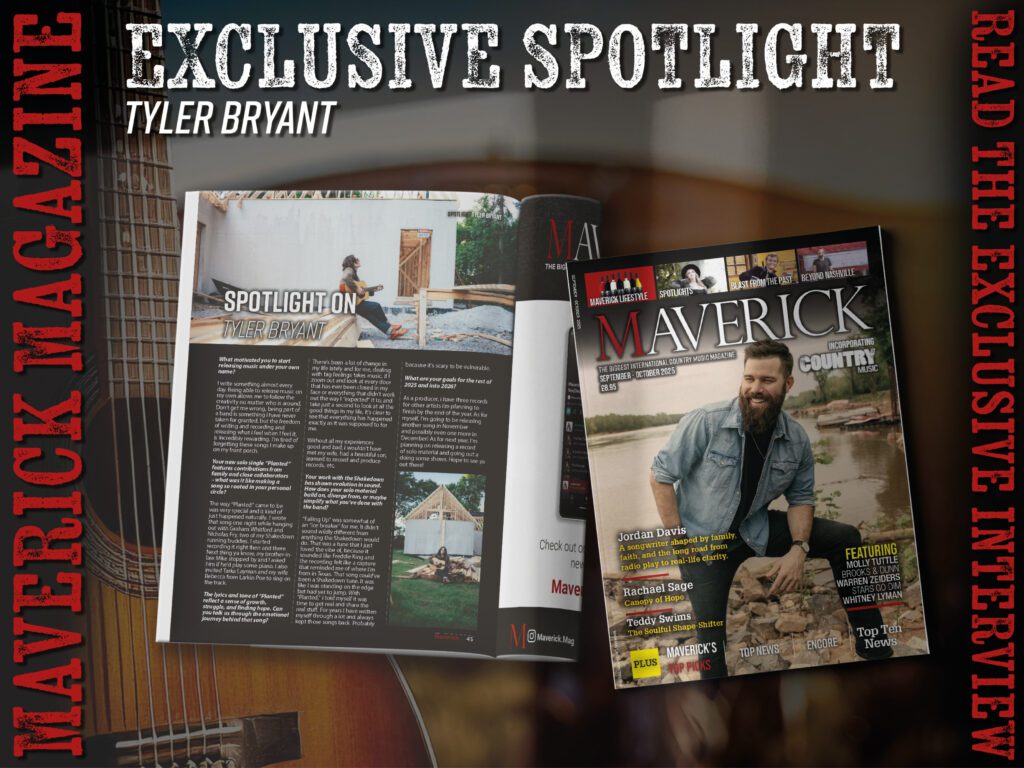
Artist Spotlight – Tyler Bryant

Bryant’s solo project strips things back to the roots, finding clarity, connection and strength in songs that reflect the twists, trials and triumphs of his journey  What motivated you to start releasing music under your own name?  I write something almost every day. Being able to release music on my own allows me to follow the creativity no matter who is around. Don’t get me wrong, being part of a band is something I have never taken for granted, but the freedom of writing and recording and releasing what I feel when I feel it, is incredibly rewarding. I’m tired of forgetting these songs I make up on my front porch.  Your new solo single “Planted” features contributions from family and close collaborators – what was it like making a song so rooted in your personal circle?  The way “Planted” came to be was very special and it kind of just happened naturally. I wrote that song one night while hanging out with Graham Whitford and Nicholas Fry, two of my Shakedown running buddies. I started recording it right then and there. Next thing ya know, my brother and law Mike stopped by and I asked him if he’d play some piano. I also invited Tarka Layman and my wife Rebecca from Larkin Poe to sing on the track.   The lyrics and tone of “Planted” reflect a sense of growth, struggle, and finding hope. Can you talk us through the emotional journey behind that song?  There’s been a lot of change in my life lately and for me, dealing with big feelings takes music. If I zoom out and look at every door that has ever been closed in my face or everything that didn’t work out the way I “expected” it to, and take just a second to look at all the good things in my life, it’s clear to see that everything has happened exactly as it was supposed to for me.  Without all my experiences good and bad, I wouldn’t have met my wife, had a beautiful son, learned to record and produce records, etc.    Your work with the Shakedown has shown evolution in sound. How does your solo material build on, diverge from, or maybe simplify what you’ve done with the band?  “Falling Up” was somewhat of an “ice breaker” for me. It didn’t sound wildly different from anything the Shakedown would do. That was a tune that I just loved the vibe of, because it sounded like Freddie King and the recording felt like a capture that reminded me of where I’m from in Texas. That song could’ve been a Shakedown tune. It was like I was standing on the edge but had yet to jump. With “Planted,” I told myself it was time to get real and share the real stuff. For years I have written myself through a lot and always kept those songs back. Probably because it’s scary to be vulnerable.   What are your goals for the rest of 2025 and into 2026?  As a producer, I have three records for other artists I’m planning to finish by the end of the year. As for myself, I’m going to be releasing another song in November and possibly even one more in December! As for next year, I’m planning on releasing a record of solo material and going out a doing some shows. Hope to see ya out there! 

Artist Spotlight – Tyler Bryant Read More »

Scroll to Top