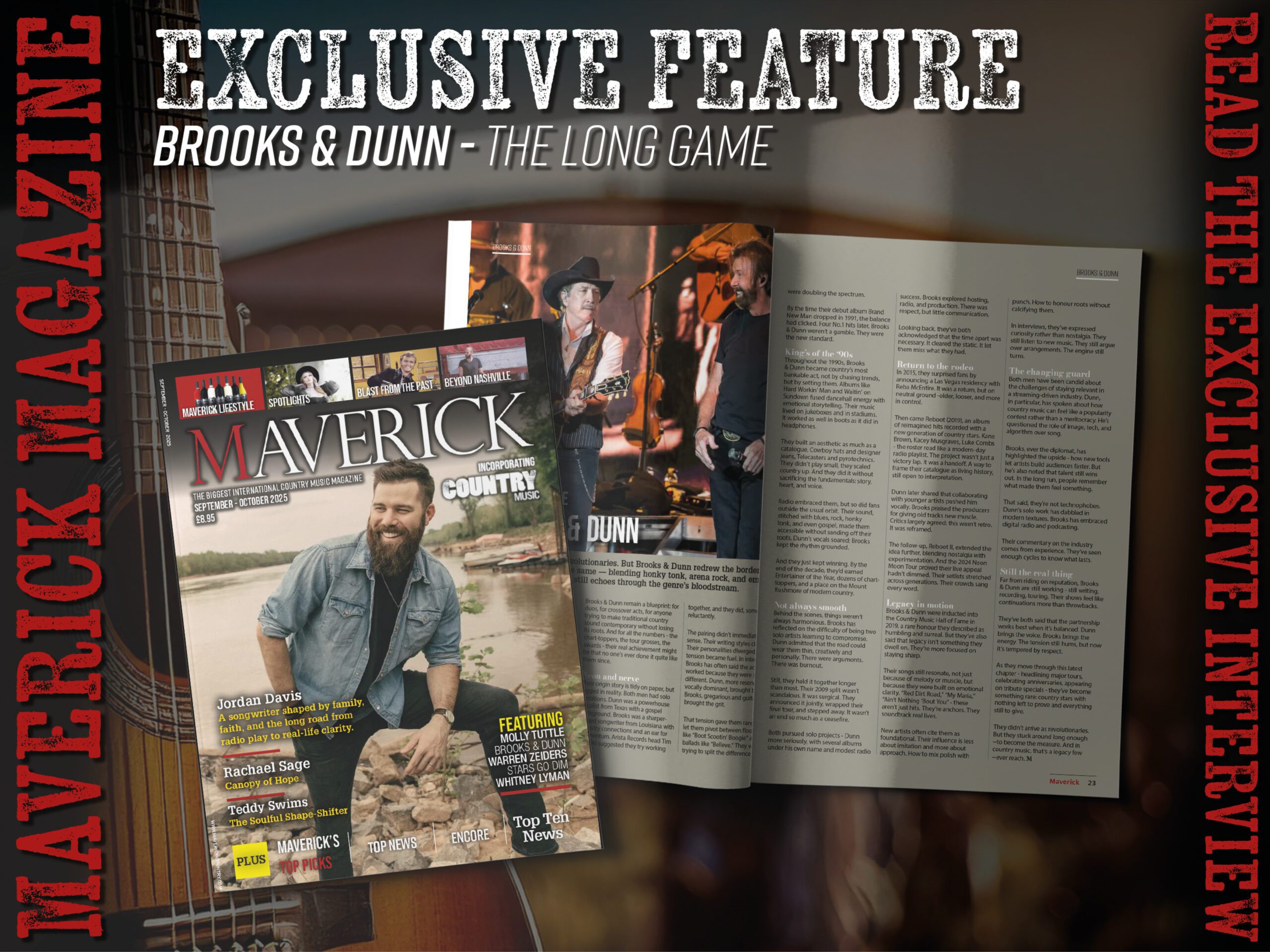
They didn’t arrive as revolutionaries. But Brooks & Dunn redrew the borderlines of country music just the same — blending honky tonk, arena rock, and emotional clarity into a sound that still echoes through the genre’s bloodstream.
When Brooks & Dunn reunited in 2015 after a five-year hiatus, it wasn’t out of necessity. They had nothing left to prove. Already Country Music Hall of Famers, with more CMA Awards than any other duo in history, they could’ve stayed gone — proud, platinum, and preserved.
But Kix Brooks and Ronnie Dunn were never interested in legacy as museum piece. Their return wasn’t nostalgic. It was purposeful. A reminder that the sharpest tools in country’s box were far from relics, they still had an edge.
Three decades after their 1991 debut, Brooks & Dunn remain a blueprint: for duos, for crossover acts, for anyone trying to make traditional country sound contemporary without losing its roots. And for all the numbers — the chart-toppers, the tour grosses, the awards — their real achievement might be that no one’s ever done it quite like them since.
Their origin story is tidy on paper, but jagged in reality. Both men had solo ambitions. Dunn was a powerhouse vocalist from Texas with a gospel background. Brooks was a sharper-edged songwriter from Louisiana with industry connections and an ear for momentum. Arista Records head Tim DuBois suggested they try working together, and they did, somewhat reluctantly.
The pairing didn’t immediately make sense. Their writing styles clashed. Their personalities diverged. But the tension became fuel. In interviews, Brooks has often said the act only worked because they were so different. Dunn, more reserved and vocally dominant, brought the ache. Brooks, gregarious and guitar-forward, brought the grit.
That tension gave them range. It let them pivot between floor-fillers like “Boot Scootin’ Boogie” and ballads like “Believe.” They weren’t trying to split the difference, they were doubling the spectrum.
By the time their debut album Brand New Man dropped in 1991, the balance had clicked. Four No.1 hits later, Brooks & Dunn weren’t a gamble. They were the new standard.
Throughout the 1990s, Brooks & Dunn became country’s most bankable act, not by chasing trends, but by setting them. Albums like Hard Workin’ Man and Waitin’ on Sundown fused dancehall energy with emotional storytelling. Their music lived on jukeboxes and in stadiums. It worked as well in boots as it did in headphones.
They built an aesthetic as much as a catalogue. Cowboy hats and designer jeans, Telecasters and pyrotechnics. They didn’t play small, they scaled country up. And they did it without sacrificing the fundamentals: story, heart, and voice.
Radio embraced them, but so did fans outside the usual orbit. Their sound, stitched with blues, rock, honky tonk, and even gospel, made them accessible without sanding off their roots. Dunn’s vocals soared; Brooks kept the rhythm grounded.
And they just kept winning. By the end of the decade, they’d earned Entertainer of the Year, dozens of chart-toppers, and a place on the Mount Rushmore of modern country.
To read the full article, see our last issue here.
Never miss a story… Follow us on:
Instagram: @Maverick.mag
Twitter: @Maverick_mag
Facebook: Maverick Magazine
Media Contact
Editor, Maverick Magazine
Tel: +44 (0) 1622 823 920
Email: editor@maverick-country.com