
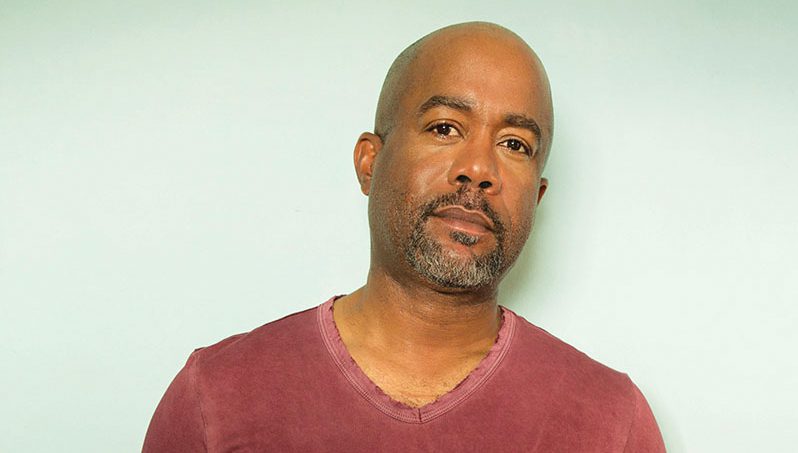
Interview: Darius Rucker – True Believer
The rocker turned country crooner tells Teri Saccone how he’s straddled the divide. With a rich baritone smooth like ‘Tupelo honey,’ singer-songwriter Darius Rucker has tapped into the mainstream twice: initially via 90s platinum pop rockers Hootie & The Blowfish and then in country in 2008, with debut single Don’t Think I Don’t Think About It off his hit album Learn To Live. CMAs followed as have more Grammys, industry accolades and touring. Although the music press hailed it as a major move, on closer inspection the crossover was fairly organic as South Carolinian Darius was raised on Hee-Haw, has listened to country since childhood and Hootie & The Blowfish extolled flavoursome rootsy folk rock. Since his country foray, Rucker’s career has flourished again. He’s collaborated with Brad Paisley, Alison Krauss, Lady Antebellum’s Charles Kelley, Carrie Underwood and Vince Gill among other country elite. And his four albums and ensuing tours have been both commercially and critically embraced. During his 2012 induction into the Grand Ole Opry, Gill described him as someone “everyone adores”. With all the adulation and adoration, CM’s expectations were high when we spoke to Darius on the eve of the C2C 2017 tour. Fortunately, the man with the golden pipes does not disappoint. He is both gracious and humble. Cognisant of his good fortunes, he offers: “I’m so lucky. I wasn’t expecting any of it,” with no mention of the absurdly hard graft involved. As Rucker is about to grace our stages, he is palpably enthused. “I’m more excited about this than I can say. Touring the UK is fantastic, because the fans there are so rabid and they really do love country music. There is a grassroots loyalty with country that does not exist in pop or rock. It’s a different beast.” Rucker grew up venerating soul, rock and the kaleidoscopic musical menu of USA’s once-diverse AM radio. But one of the first country stars he was enamoured with was Kenny Rogers. “Kenny’s music is so real, his songs are great stories, so vivid and cinematic and he drew me in as a young kid. I loved growing up in the 70s because you could hear Kenny, Cheap Trick, Al Green, The Beatles and Buck Owens all on the same channel.” When he appeared on Radney Foster’s 1999 album See What You Want To See it was a watershed moment for him. “I knew then I really wanted to go in that direction. I told the guys in the band (Hootie) that I was gonna make a country album even back then.” When Hootie went on hiatus in 2008 the timing couldn’t have been sweeter and Rucker began forging a country path. “I got lucky going to Nashville and I didn’t think it was necessarily going to work, and neither did my representation. We were not presuming it was gonna explode for me. But luckily we made such a great first record (Learn To Live). We then literally drove around the country,” he adds, “and we did a national country-radio tour to support it. Some people thought I was nuts, but I wanted to prove myself to Nashville. On that radio tour, I had programmers tell me they were unsure if their audience would accept me. But I knew that I had to start with country that way. Having country music accept me made me so happy I do what I do. Okay, it’s not curing cancer, but it made me feel like I am on the right track.” This modest assessment comes despite the fact that H&TB sold in excess of 26 million copies of Cracked Rear View, making it among the most successful US-made albums in history. Yet Rucker is not one who tends to sing his own praises. Given that Nashville can be quite unforgiving to crossover artists, why does he think he was accepted as authentically country? “I think the main reason is because people knew this was not about money or being a superstar. I would have done this in the basement of my house with my friends if that was as far as we got. I was making this music for me.” One of the recurring themes in Rucker’s lyrics is also a country staple: family. The poignant It Won’t Be Like This For Long bears this out. “The personal songs are best for me as a writer. I could try fictional songwriting, but it wouldn’t be honest. I write about what I live both now plus from my past experiences, so the real-life topics are my trademark.” He says his songwriting is unpredictable and ideas often transpire without plotting or provocation. “Melodies and lyrics come to me in a variety of ways. But they often appear simultaneously. One thing he won’t ever do, however, is write a song and then simply ‘countrify’ it in the studio. “I won’t take a pop song, stick fiddles or a banjo on it and call it ‘country’,” he explains emphatically. Since we already know what he is, I probe him about who he is. He takes a few seconds to ponder the question before replying: “Who I really am is a father. That is my number-one purpose. To have contented, healthy children is a privilege for anyone. And I never forget it.” The answer is poignant, because his mother raised him and his siblings pretty much singlehandedly, with their dad absent and only visible to them on Sundays right before church services. “For a time, we lived with cousins and aunts and we were a very close family and we still are now.” Perhaps his familial ties keep him living in his hometown of Charleston, when he could choose to reside anywhere. “Home is truly here, in every way imaginable,” he explains. Not only do his roots in the historic city run deep, he also is a hands-on philanthropist, having set up two charities. His golfing charity (he’s an avid player and a close pal of Tiger Woods) raises funds for
Interview: Darius Rucker – True Believer Read More »