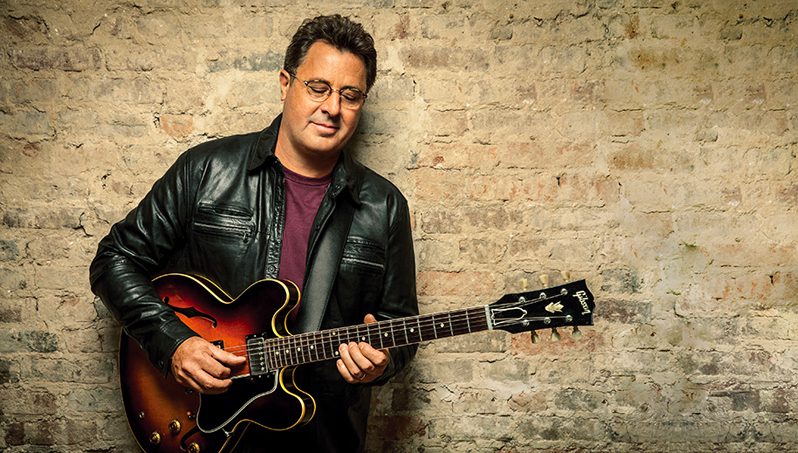
20 grammys and countless hits later, Vince Gill is still at the top of his game, writes Paul Sexton. On our way to Nashville’s hallowed Ryman Auditorium, we mention to a record-company person that we’re going to meet Vince Gill. “Ah yes,” they reply, with a warm smile. “The Mayor of Nashville.” It may be an honorary title, but Music City has no greater ambassador than a 20-time Grammy winner genuinely loved and respected by everyone involved in the business, and many more besides. He’s one of those for whom no surname is required: it’s just Vince, country music’s close family friend, Nashville’s favourite adopted son for decades. Not bad for a bluegrass picker and Beatles fan from Norman, Oklahoma. When we meet backstage at the famed venue, known to all as the Mother Church of Country Music, Gill is sitting alone in a small room strumming and studying potential tunes for an appearance at an all-star radio showcase. We tell him about his affectionate appellation. “I haven’t been paid yet,” he laughs warmly. “But I love it here, I love to help out, I love to chip in and do my part, and I think I always have, ever since I’ve been here. I made my first trek here 42 years ago, and made one of my very first records here. So I’ve always been drawn to the city. I love the community of it, the spirit of it, the kindness of it. This place is surrounded with a lot of really kind people, and it makes you willing to want to help out.” There was, he confides, at least one moment of doubt, very early on. “I moved here from Southern California, which is 75 and sunny every day. I showed up here and it was 17 below zero. It was freezing. ‘What have I done?’ “I didn’t move here until ’83,” Gill continues, “but I made a boatload of trips here to work on records, and work with other people and tour, so I had about eight good years of a lot of time in Nashville and always felt like I would wind up here. That opportunity was finally the right time to come, and I’m not going anywhere else, that’s for sure.” All this time later, it was only right that, as the CMA Awards prepared to mark its 50th event last November, the all-star single Country Forever that marked the occasion featured Gill among its all-time greats, alongside Dolly Parton, Willie Nelson, Charley Pride, Ronnie Milsap, Randy Travis et al. As he prepares to turn 60 in April, Gill is a statesmanlike representative of the music and the city he adores. But his role is far more than that of a country figurehead. He’s as deep in the trenches of recording, performance and collaboration as he always was, and his diary for last year was as packed as ever, with two album releases inside just seven months. His elegant, 14th album in his own name, Down To My Last Bad Habit, was followed in September by a delightful new endeavour with his part-time compadres The Time Jumpers, entitled Kid Sister. Time traveller 2017 looks every bit as eventful. After finishing last year with his Christmas At The Ryman shows with his wife of nearly 17 years, Amy Grant, he’s swiftly back out on the road, and in March will reunite with his pal Lyle Lovett, for the third year running, on a nine-city US schedule. The humour, you can bet, will be bone dry. On 12 February, Vince has a date at the 59th annual Grammy Awards, courtesy of not one but two nominations for that Time Jumpers set. As both an ever-active songwriter and a fervent traditionalist, both will have given him great satisfaction: Kid Sister is nominated for Best Americana Album, and its title track, his own composition, is up for the Best American Roots Song gong. Down To My Last Bad Habit, I tell him, would be worth the price of admission for the title alone. He laughs. “The title track is a song I wrote with Big Al Anderson, who was part of a pretty legendary band here in the States called NRBQ, a lot of people’s favourite rock ’n’ roll band in history. “I got the title from a conversation at breakfast. I was talking to a friend and said ‘What are you up to?’ and he said ‘Well, I’m doing alright, I’m down to about my last bad habit,’ and I said ‘Man! May I please have that? I want to write a song with that in it.’” This was, by design, an album often displaying the crossover, soft-rock side to which Vince’s magnificent, mellifluous voice and dexterous guitar playing are so well suited. Indeed, four years before he made his debut in his own name with the Turn Me Loose record of 1984, Gill’s honeyed tones infiltrated the American pop Top 10, when he sang Let Me Love You Tonight, with his early band the Pure Prairie League. “It’s fun for me,” he says of the solo album. “I don’t think it’s a very traditional country record for me, in that I did a record two years ago with Paul Franklin, the great steel player, called Bakersfield, where we played half Buck Owens songs and half Merle Haggard songs. Then when I play with The Time Jumpers, that really gives me the opportunity to invest in a lot of traditional country music – real twangy, the stuff I really love. “So this record, I had a little more freedom to chase myself as a guitar player, and not try to have it be so steeped in that [tradition]. But there’s one on there that’s a real traditional country song I wrote for George Jones after he passed — another one of our great icons that should be on the Mount Rushmore of hillbilly singers.” The song in question is the typically graceful album closer, Sad One Comin’