

19 January 2016

The Corrs

Making Magic Hyde Park in the summertime: An audience of 50,000. Andrea Corr holds the microphone out to the crowd and asks them to sing along with her. She smiles and glows with the Corr family’s natural charm but her nerves are clear too – no sound-check, no large-scale performance in ten years and weeks of tears before the show… She’s met with a chorus of voices singing along to smash hit Runaway, swaying to the dreamy love song. For the first time, her Dad Jerry isn’t physically present to support her career but her sisters Sharon and Caroline and brother Jim are beside her – and the band’s children are backstage watching their parents play as a band on stage for the very first time. The Corrs are back. The Corrs – Andrea (lead vocals, tin whistle), Sharon (violin, vocals), Caroline (drums, percussion, piano, bodhrán, vocals) and Jim (guitar, piano, keyboards, vocals) – were an international success in the 90s and early 2000s, playing a unique blend of Celtic pop and folk rock – and bringing Celtic rooted music to a mainstream audience. Their most successful album, TALK ON CORNERS, was the UK’s highest selling album in 1998 and went multi-Platinum in Australia; Third Corrs album, IN BLUE, reached number one in 17 countries. Hits such as Breathless, Runaway and What Can I do? and five studio albums won the band a loyal fanbase and critical success. Now, they have returned after a ten year hiatus, that was decided whilst they stood at the peak of success. Charlotte Taylor talks to Andrea and Jim Corr about their return to the industry, much-awaited new album and a comeback tour this year. Back on stage The Corrs released their sixth studio album WHITE LIGHT on November 27, 2015, following the announcement of their return to the industry (as a band) on Chris Evans’ breakfast show on BBC Radio 2, an impressive comeback performance as part of Radio 2 Live in Hyde Park 2015 and a series of smaller showcases. Launching their album was “amazing” and sharing this symbolic new release “after a year’s work … has been intense,” says Andrea. “As far as we are concerned, if you are going to come back after ten years it has got to be great,” she explains with an air of grounded confidence. “We have really pushed every song to the limit. I feel that each of us is very, very emotionally connected to this work and to each song. So it was kind of, it is kind of, almost a relief letting it go, to be honest. Letting it go out into the world – and then what will be will be …” The Corrs were active in the industry from 1990 – 2005, creating five studio albums and with Sharon and Andrea also pursuing solo careers. Ten years is quite the hiatus But the siblings didn’t worry Jim is just as “delighted with how it is going” as his sisters. “It feels wonderful. We really missed playing together and we only realised that to the extent when we got back up on stage and in Hyde Park.” “You know, it is quite funny, it feels really natural,” Andrea explains. “Even though our first gig back was when we were in the middle of making the record and that was Hyde Park, so that was obviously seriously deep end stuff – in front of 50,000 people! As crazy as that is after ten years, there were certain aspects of it that felt like it was yesterday that we had done it [last].” “…But then at the side of the stage we had proof that it wasn’t! Our children. The ten years was there in people on the right of the stage.” Since letting the band lie, Andrea, Caroline, Sharon and Jim have all lived lives centred around their families, with eight children between them. “I think that [with] the distance and the time away, we focused on our own individual lives … It gives you a greater perspective on the whole thing – that really we are here to enjoy it now,” recounts Andrea. And now they are back not out of boredom, not out of label pressures but “because of the music, because we were inspired together. And we do feel that we bring out the best in each other. We are loving being back and playing together.” I ask them both what it could have possibly meant to have seen the the crowd sing along to Runaway at Hyde Park after ten years of being parents – not musicians in an internationally successful band? “To be honest it was unbelievable. That was an incredibly emotional day for me … for all of us. But it built up for me. I went through crying maybe once a day for the weeks before [to] crying the whole day the day before,” Andrea admits. “It was the size of it, you know, the emotional gravity of being back with my sisters and brother on the stage and then also that it was the first that neither of our parents have seen – in the physical dimension anyway. So it really was really emotional – but the welcome we got then further added to that. I mean second song in we did Runaway and the whole crowd sang it. It was a real moment, for us anyway.” “…Especially through the quiet part of Runaway, it was amazing,” says Jim. “And Breathless. We had some technical issues on the first song and we were a little bit nervous,getting up on the stage because we didn’t have a sound check … without a sound check you don’t know how things are going to go. But as soon as we settled into it and once we entered in the second song and everything was going fine, we started to relax and it was wonderful to hear the crowd sing along with the songs.” Making magic again The
The Corrs Read More »

Eva Cassidy

Nightbird On November 2, 1996 music lovers across the world lost one of their most treasured and loved artists. Yet, the tragedy is that at the time, they were still to discover her wealth of talent. To commemorate 20 years since Eva Cassidy’s passing, Megan Gnad speaks to her family, label and admirers, about her posthumous career, the iconic Blues Alley recordings, the price of fame and the legacy the sweet songbird leaves behind. Bill Straw remembers the life-changing phone call as vividly as if it were yesterday. The President of Blix Street Records listened carefully as singer Grace Griffith relayed with urgency how he must listen to a relatively unheard of young singer from Washington D.C. “She said ‘you have to hear this wonderful singer. This wonderful nightingale, I’m afraid we’re going to lose.’ She sent me a tape and it was cued up to Fields Of Gold. I knew immediately, within seconds, she was extraordinary and by the time I’d heard the whole album, I knew she was one of the best ever.” Tragically, within one month of hearing Eva Cassidy’s glorious recordings, he learned the singer had passed away at just 33 from melanoma. Family and friends mourned the loss of a loved daughter, sister, friend and talented musician, but, for an artist who would go on to have such a massive posthumous career, it now seems unfathomable that they wept in relative privacy. The outpouring of grief from the public would follow. Once the world realised what it had lost, music lovers took Eva to their hearts. She is now recognised as one of our greatest female musicians, with an influence on almost every genre, including jazz, blues, country, gospel, folk, pop and rock. The fact that her music even had the chance to be shared can be put down to a series of luck and good judgement, and a public desire to listen and make sure this songbird would never be forgotten. For that we have a set of recordings to thank from one special night at the Georgetown jazz club, Blues Alley. These tracks ensured she became a superstar and have now been reproduced and packaged into a 31 track album and DVD, NIGHTBIRD, set to commemorate 20 years since her untimely death. On the night of January 2, 1996, Eva and her band, made up of Chris Biondo (bass), Lenny Williams (piano), Keith Grimes (lead guitar) and Raice McLeod (drums) took to the Blues Alley stage, using money from the small pension Eva had cashed in at her tree nursery job.“We thought we’d get airplay, and sell a thousand copies so Eva could put some money toward a PA system,” explains Biondo. The band was booked for two nights and with family, friends and a few members of the press in the audience, it was a resounding success. They had nailed it in one take. But as they listened to the recordings back, their hearts sank. The lighting system had somehow created a buzz throughout the entire show and they were swiftly deleted. No one has ever heard them since. Suddenly the pressure was on. It was January 3 and Eva was suffering from a cold. While she gave it her all, she was not satisfied with the recordings and her first thought was to scrap the lot. Fortunately, once she heard the final mixes, she was persuaded by her band mates to allow the original, 12 track, LIVE AT BLUES ALLEY album to be released – with one condition. The album would end with her studio recording of Oh, Had I A Golden Thread, a performance she was particularly proud of. It was to be the only solo album Eva Cassidy released in her lifetime and helped her work become promoted to its legendary status. Within ten months of the showcase, Eva was gone, but Bill Straw had been keeping a close eye on her wellbeing, through Eva’s friend, Grace Griffith. “I knew that she was not long for this world, and I also knew she was most likely to be famous, and wasn’t going to be around to enjoy it,” he says. “I ran around in my car for months listening to it and it was just profoundly sad. I didn’t know how her parents would feel about it, whether they would have her music marketed, or if it would be too painful. I basically wasn’t thinking about business at all.” Bill says he had enough experience to know he was hearing a great performer but he also knew a lot of major companies had passed on signing her. “I knew audiences would embrace Eva immediately,” he says. “The individuals within [the industry] certainly knew what they were hearing, but they didn’t know who would buy it. They were trying to create packages that they could market using mainstream radio, and mainstream radio wouldn’t play Eva Cassidy, because it didn’t fit the formula.” By April 1997, Bill was in Washington working on Grace’s project, when he was invited for dinner with Eva’s parents, Barbara and Hugh Cassidy. He says her death hit the artistic community in D.C. “pretty hard” as many found out about her and lost her within the same timeframe. With this in mind, there was a desire from her parents to honour this groundswell of love and, with Chris Biondo’s help, they soon put out EVA BY HEART. By this stage, Bill had heard the original LIVE AT BLUES ALLEY, EVA BY HEART and the 1992 duet album with Chuck Brown, THE OTHER SIDE. He was soon harbouring plans to create a super album. With her parents’ support, he compiled the now-famous, SONGBIRD record, featuring a selection of songs from these previous recordings, notably Fields of Gold, Autumn Leaves and People Get Ready. Upon its release, the album’s impact and popularity occurred in stages, and soon the press were writing favourable reviews and radio stations were playing the songs. “We got little breakthroughs in different areas,” says

Eva Cassidy Read More »

Walter Trout

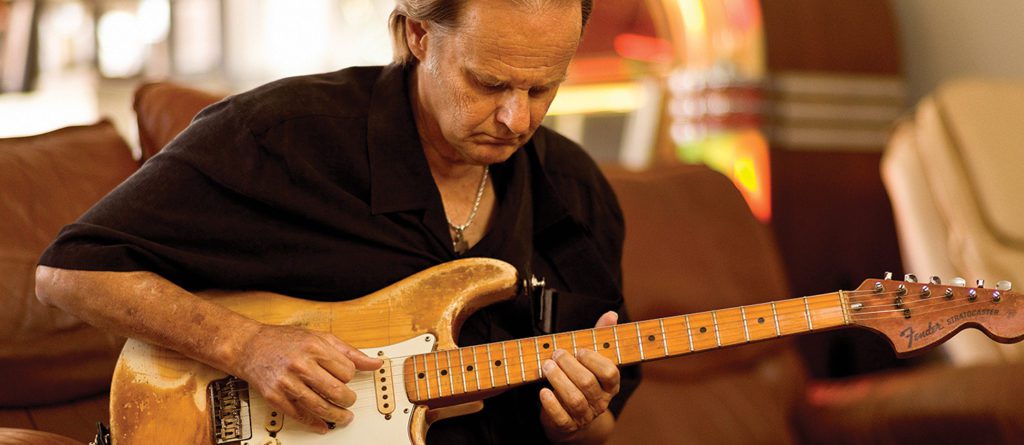
Starting Over Charlotte Taylor meets with bluesman, Walter Trout, to talk about overcoming his extremely close brush with death, the emotional new album BATTLE SCARS that followed and a subsequent tour that Walter “never would have considered” whilst lying on his hospital bed. BATTLE SCARS is Walter Trout’s 42nd album release; a blues guitar icon, he has been playing music for half a century, gaining international acclaim and receiving honours that include two Overseas Artist of The Year wins at the British Blues Awards. In fact, it was just before he was taken ill that Provogue Records had planned a ‘Year of the Trout’ worldwide tour and marketing campaign to celebrate his 25 years as a solo artist. But it was not to be. Darker times, living on the streets in the 70s, caught up with a now settled Walter, who was a whole world away with a successful music career, passionate and loyal fanbase and a family he adores. At the start of 2014, Trout was placed in intensive care, suffering from liver disease, losing staggering amounts of weight and muscle, and with no chance of recovering without a transplant. To his complete disbelief, Walter’s friends, family and fans raised almost a quarter million dollars in an online campaign to help pay for the expenses involved in receiving a new liver and the transplant surgery. This wonderful display of love and loyalty spurred on Walter, as he readied himself to face the next battle – relearning what once came naturally, playing the guitar and writing new songs once again. He had wanted to write a positive album to reflect his new lease of life, but found that what he needed to do was to write about his pain and his experiences. Even though Walter Trout has been through hell and back and his accounts of these times are vivid and heartbreaking; they, like Walter, are also full of hope. Speaking with him, he displays gratitude, humility as well as pride for what he has achieved, and hope for the future of his music and his genre – and he’s also still full of that matter-of-fact charm that he’s become so loved for in the industry. I begin our conversation with a congratulations for everything that Walter has achieved since his recovery – a new album, live shows and now a worldwide tour. But was a return to music always his goal along the way? “Never at all, if you told me a year ago I would have said ‘no way!’” Walter begins. “When I was at my worst I would say to my wife ‘if I can just survive this and still get to be with you and be with our kids, if I don’t play again – so be it…’ “I was prepared to live my life listening to records and watching YouTube videos and saying ‘that’s what I used to do.’ I had visions of cleaning a table in a restaurant or something and being a bus boy and saying to somebody ‘oh I used to play the guitar.’ – And I would have done it, but I’d have been hollow.” After his transplant on May 26, 2014, Walter moved home and started on the the road to becoming himself again. He made the decision to relearn how to play. “I lost more than half of my body weight. I lost 120 pounds – and that was muscle, not just fat. I had no muscles in my arms, I was skin and bones. I attempted to play when I was still in the hospital. My oldest son, John, came over … he brought me a Stratocaster and said ‘here, you have to keep in touch with who you are.’ I tried to get a note to come out and I could not press the string to the fret. I didn’t have the strength. I broke down and I said ‘take it out of here, I can’t look at it, I can’t think about that!’” But when Walter moved back home he started receiving physiotherapy and he used this time to work on reteaching his muscles to play the guitar. “I would sit on my couch and at that point I got determined. What else do I have to do? I’ve got three hours a day at this physical therapy place and then I’m home. So it would be get up and try to walk, and sit on the couch for hours and try to get it back… “It was still there. I still knew how to do it, I was just physically unable to do it … But little by little it started coming back.” The first time Walter played in front of anyone again was New Year’s Eve 2014. “I played two songs in my driveway for the neighbours with my kids. We have a family tradition, we set up in the front lawn, every New Year’s Eve at midnight we play to the neighbours until the cops come. We’ve done it for 12 years. So I played two songs. I did Born To Be Wild by Steppenwolf and Fortunate Son by Creedence. I played and I sang – but then I had to sit down, I was gone.” His second performance was a very different affair! “The first time I actually got in front of an audience though was not til June 15 at the Royal Albert Hall [2015], so that was nine months after I got out. It took me that long to feel that I could be in front of an audience and I was still very apprehensive … It wasn’t like going to the local pub.” “As soon as I counted the four and that band came in – I was at home.” These memories are incredibly emotional and we pause for a second as Walter collects himself. “As soon as they came in and they started playing and I saw those faces I just [thought] ‘I’m at home, this is

Walter Trout Read More »

Scroll to Top