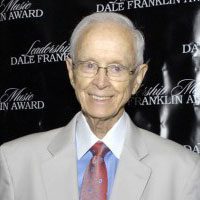
Country Music Hall of Fame member Jim Foglesong, a record label executive who helped launch the careers of Garth Brooks, George Strait and Reba McEntire, died Tuesday (July 9) at age 90. A classically trained musician, Foglesong also became a key player in the careers of such country music superstars as Roy Clark, Barbara Mandrell, the Oak Ridge Boys and Don Williams. In his later years, he lectured at Vanderbilt University’s Blair School of Music and headed the music business program at Trevecca Nazarene University in Nashville. James Staton Foglesong was born July 26, 1922, in Lundale, W.Va., a tiny coal-mining community. His father was an accountant for a coal company. “My mother and dad loved music,” Foglesong told CMT.com in 2004, the year of his induction into the Country Music Hall of Fame. “Dad sang bass and played a little violin — not fiddle. … We sang and listened to music all the time, and it wasn’t country music. Country music at that time was not that prevalent. … We always had the Metropolitan Opera on the radio on Saturday afternoons. When we drove over to Logan County or Fayette County to visit our relatives, we sang from the time we started the car until we got there. Always in harmony.” During his teen years, Foglesong sang on a live 15-minute radio show in West Virginia called South Charleston Night. Soon after the U.S. entered World War II, Foglesong joined the Army but continued with his music. “We always had a quartet or a trio,” he said. He left the Army in 1946. Then, backed by the G.I. Bill of Rights, he was accepted at the Eastman School of Music in Rochester, N.Y., where he majored in voice. Upon graduating from Eastman in 1950, Foglesong moved to New York City with the aim of becoming a professional performer or music teacher. While searching for a steadier job, he served as a tenor soloist at First Baptist Church and sang in a double quartet at the Avenue R Temple, both in Brooklyn. After about a year in the city, a friend from Eastman helped him get a job at Columbia Records. “This was in ’51, and the [long-play] record was only three years old at the time,” he said. “So [Columbia] had these vast vaults of 78 rpm records that needed to be put on tape [to transfer to the new format]. In classical music, there was a lot of splicing to be done. A movement in a symphony can be 12 or 15 minutes in length, and on the old 78s, the most you could get on one side would be three and a-half or four minutes. … They needed a good musician to make sure the splicing was done appropriately.” That became his duty. Although he found the job challenging and enjoyed working with some of the classical musical giants of the day, Foglesong still wanted to be a performer. So when he was offered a singing spot in the touring company of Fred Waring’s Festival of Song, he accepted it. By this time, however, Columbia was so pleased with his work that the company offered him a leave of absence to tour, and he returned to the label after six months on the road. Following his return to Columbia, the company started a new label, Epic, where he went to work as “a musical flunky.” One assignment was to listen to foreign records of all types and help decide which ones Epic would release in America. On the side, he did background singing for Columbia recording acts. “Little by little, I started inching myself into production,” Foglesong recalled. The first album he produced for Epic was a simulated minstrel show called Gentlemen, Be Seated. “Back then, the LP was so new that it wasn’t star-driven,” he explained. “A lot of the albums were sold as concepts.” With both his singing and producing careers gaining momentum, Foglesong opted to abandon performing and work primarily in the record business. He still sang occasionally, once even providing vocal backup in the recording studio for the new rock ‘n’ roll group, Dion & the Belmonts. He stayed with Columbia/Epic for 13 years before taking a post at RCA Records, where he remained for another seven years. It was during his tenure at Columbia that he began coming to Nashville, first to listen to songs for the pop acts he was producing — among them the great Roy Hamilton — and later to record some of these same acts, including the Ames Brothers and Al Hirt. In the early ’70s, he relocated to Nashville to run the country division of Dot Records, whose roster then included Roy Clark, Hank Thompson, Tommy Overstreet and Joe Stampley. During his second year on the job, Foglesong happened to hear a master recording of Donna Fargo’s insanely peppy “The Happiest Girl in the Whole U.S.A.” and picked it up for Dot. The album that grew from that single sold more than a million copies. In 1973, Foglesong produced Clark’s first and only No. 1 single, “Come Live With Me.” Dot was taken over by ABC Records in the mid-1970s and transformed into ABC/Dot. One of Foglesong’s first signings to the newly combined label was Don Williams. Foglesong was subsequently named president of the label. In this capacity, he acquired for ABC/Dot another promising master, this one from the tiny Crazy Cajun label. It was Freddy Fender’s doleful “Before the Next Teardrop Falls,” which zoomed up the charts in 1975 to hold the No. 1 spot for two weeks. Later on, ABC/Dot also signed Mandrell and the Oak Ridge Boys. MCA Records purchased and absorbed ABC/Dot in 1979, and Foglesong took over the label’s country division. During the next five years, he also presided over the recording fortunes of Merle Haggard, Conway Twitty, Loretta Lynn andJohn Conlee — and signed Strait and Reba McEntire to the label. Foglesong left MCA in 1984 and took over the